
The Accessible UK: A Wheelchair User’s Guide to Britain

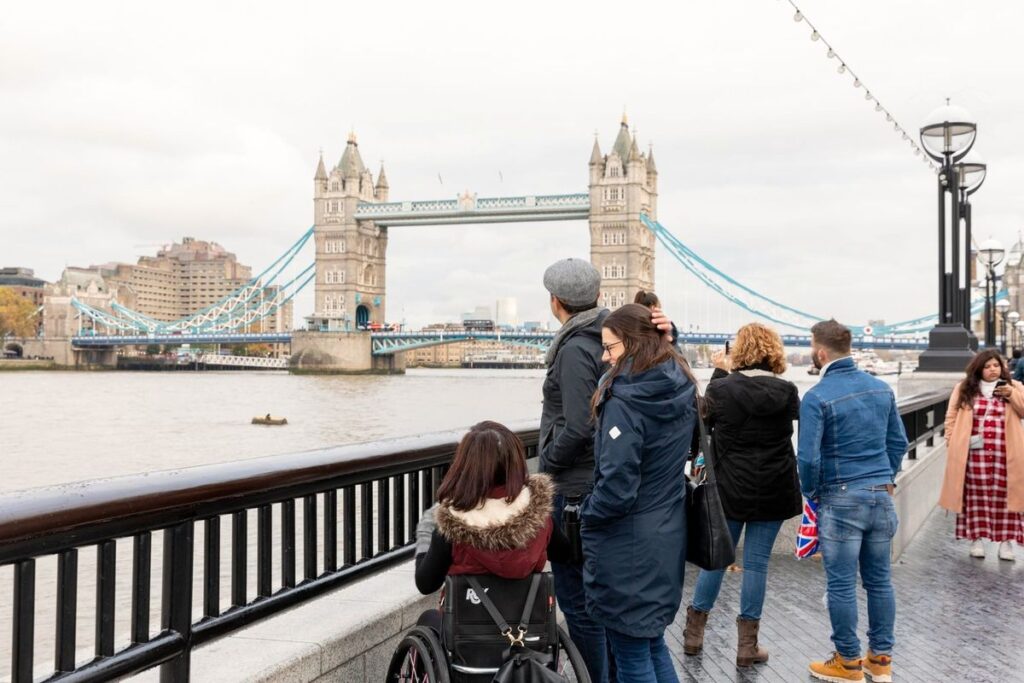
UK wheelchair accessible travel – wheelchair user near Tower Bridge in London

UK wheelchair accessible travel can combine historic cities, major museums, scenic rail journeys, coastline and countryside, but accessibility varies considerably from place to place. Modern attractions and transport systems often provide good facilities, while centuries-old buildings, cobbled streets, older railway stations and rural terrain can require much more preparation.

The UK also has unusually detailed resources for researching accessibility before travelling. These can make planning much easier, but they do not remove the need to check entrances, gradients, transport connections and facilities that are particularly important to you.

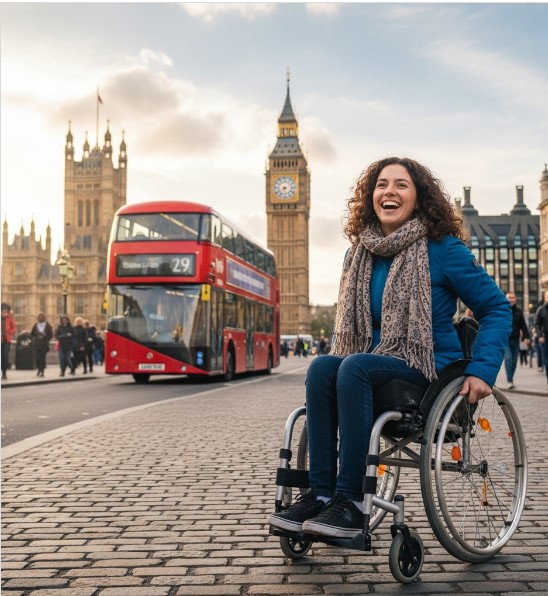
Wheelchair user near Big Ben and a red double-decker bus in London

What Accessibility Really Looks Like in the UK

The Equality Act 2010 provides an important legal framework for disabled access in Great Britain. Service providers have a duty to make reasonable adjustments so that disabled people are not placed at a substantial disadvantage, and those adjustments can include physical changes as well as changes to services and procedures. However, the law should not be interpreted as a guarantee that every building, attraction or transport connection will be physically accessible to every wheelchair user.

That distinction matters particularly in a country with so much historic infrastructure. A museum may have created a step-free entrance without making every historic room accessible, while a railway station may be described as step-free even though the practical route involves lifts or a particular platform entrance. Accessibility therefore works best when treated as a collection of specific features rather than a simple yes-or-no label. For more information about the legal framework, the UK government explains the principle of reasonable adjustments under the Equality Act.

Planning an Accessible UK Trip

Two particularly useful resources are AccessAble and Euan’s Guide, but they provide information in different ways. AccessAble publishes Detailed Access Guides based on surveys of thousands of venues across the UK and Ireland. Its surveyors collect measurements, photographs and detailed information about entrances, toilets, lifts, parking and other facilities, allowing travellers to decide whether a venue works for their individual requirements.

Euan’s Guide adds another perspective by providing disabled access information and reviews based on real visitor experiences. This distinction is useful: official information can tell you that a lift exists, while personal reviews may reveal what navigating the venue actually feels like. Recent Euan’s Guide surveys also show why checking these details remains important, with disabled respondents continuing to report barriers and a lack of confidence when visiting unfamiliar places.

Using both types of resource can give a more complete picture before travelling. Detailed measurements are particularly valuable when dimensions, gradients or transfer arrangements matter, while first-hand reviews can highlight practical issues that may not be obvious from an attraction’s standard accessibility information.


Getting Around the UK by Wheelchair

The UK has extensive public transport, but accessibility is not uniform across the network. Modern buses, trains and stations may be straightforward to use, while older infrastructure can introduce lifts, ramps, platform gaps or alternative entrances into what initially appears to be a simple journey. Checking individual routes rather than relying on general statements about the transport system is therefore particularly important.

There is also no single transport authority covering every journey across England, Scotland, Wales and Northern Ireland. Operators, assistance arrangements and local transport systems differ, so information should be checked with the relevant provider for each part of an itinerary.

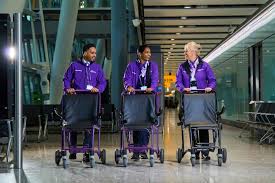
Airport assistance staff with wheelchairs in a UK airport terminal

Flying to and from the UK

Disabled and less mobile passengers are entitled to assistance at UK airports. The UK Civil Aviation Authority recommends requesting the assistance through the airline, travel agent or tour operator when booking or at least 48 hours before departure, giving the airport and service provider time to prepare the required support.

Be specific about the assistance you need and provide information about your wheelchair or mobility device, particularly when travelling with powered equipment and batteries. Procedures for taking a personal wheelchair to the aircraft and returning it after landing can vary according to the airport, aircraft and operational circumstances, so these arrangements are worth confirming before departure rather than assuming that the wheelchair will automatically be handled in a particular way.

The UK Civil Aviation Authority’s assisted travel guidance explains how to request assistance and what passengers can expect at the airport.

London Transport

London has an extensive transport network, but the easiest mode can depend heavily on the route. Buses are particularly useful for many wheelchair users, while the Underground requires more careful planning because step-free access is not available at every station and the gap or height difference between platform and train can also matter.

Transport for London’s Journey Planner and TfL Go app allow travellers to plan around mobility requirements, and TfL publishes step-free maps and accessibility information. Some Underground platforms also have raised sections known as platform humps that provide level access to trains, but these are specific to particular boarding points rather than a feature of every platform.

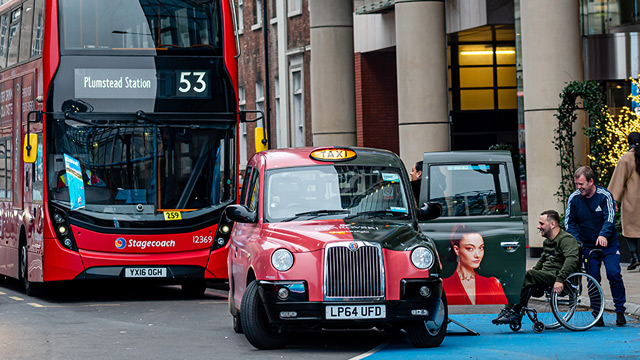
For this reason, checking the entire route — including interchange stations — is more useful than confirming only that the starting and destination stations are accessible. The TfL accessible journey planner also provides information about disruptions, lifts and accessible travel options. London’s licensed black cabs provide another useful alternative, particularly for shorter journeys or routes involving difficult Underground connections. They are designed to accommodate wheelchair users, although vehicle layouts and the practical suitability for individual wheelchairs can still vary.


Travelling by Train

Rail can be one of the most useful ways to travel between British cities, but wheelchair spaces are limited and station accessibility varies. National Rail states that most trains can accommodate wheelchairs up to 700 mm wide and 1200 mm long, although a small number of older trains have more restrictive dimensions.

Passenger Assist can provide help with boarding, leaving the train and navigating stations. Importantly, assistance does not always have to be booked in advance: National Rail operates a Turn Up and Go approach for passengers who arrive without a reservation. However, where wheelchair-space reservations are available, booking one is recommended because each train has only a limited number of dedicated spaces. The National Rail accessible travel guide provides current information about Passenger Assist, wheelchair spaces and individual train operators. Eligible travellers may also qualify for a Disabled Persons Railcard, which provides discounts on many rail fares.

Accessible Cities and Cultural Experiences

One of Britain’s advantages for wheelchair travellers is the concentration of museums, galleries and attractions within its cities. At the same time, historic centres can contain cobbles, narrow pavements, steep gradients and listed buildings that cannot always be adapted in the same way as modern structures. The experience can therefore differ considerably even between attractions only a few streets apart.

London

London offers an enormous range of museums, galleries, theatres and major attractions, many of which provide step-free access and detailed accessibility information. The challenge is often not finding accessible places to visit but connecting them efficiently, particularly when an Underground station, lift outage or long distance complicates the route.

The city is therefore particularly suited to planning by neighbourhood rather than crossing London repeatedly during the same day. Combining nearby attractions can reduce transport changes and make it easier to adapt the itinerary if a lift or station becomes temporarily unavailable.

York

York is a good example of the balance between accessibility and historic character. The compact centre contains medieval streets and old buildings, which means surfaces and entrances vary considerably, but several major attractions have made substantial adaptations.

The National Railway Museum is particularly relevant for wheelchair users because of its large indoor spaces and railway collections, while the city itself rewards careful route planning. In the historic centre, checking street surfaces and entrances in advance can be just as important as checking accessibility inside the attraction.

Glasgow

Glasgow combines grand historic architecture with several large cultural attractions that provide modern visitor facilities. Museums such as the Kelvingrove Art Gallery and Museum and attractions including the Glasgow Science Centre can form part of an accessible city itinerary, but individual facilities and routes should still be checked before visiting.

The city also illustrates why the UK should not be treated as a single accessibility system. Scotland has its own transport operators and services, so travellers beyond Glasgow should check Scottish providers rather than assuming arrangements will be identical to those in England.

Belfast

Belfast adds Northern Ireland to a UK itinerary and again requires checking local transport and accessibility information separately. Titanic Belfast, one of the city’s best-known visitor attractions, was built as a modern visitor experience and provides accessibility information for disabled visitors, while the Ulster Museum offers another major cultural stop near the Botanic Gardens.

Northern Ireland should not simply be treated as an extension of the transport arrangements used in Great Britain. Local services and assistance systems differ, making destination-specific planning particularly useful.

Beyond the Cities: Countryside, Coast and Waterways

Wheelchair-accessible travel in Britain is not limited to cities and museums. Countryside access is much more dependent on terrain and the type of mobility equipment being used, but several organisations have developed ways of making outdoor experiences possible beyond conventional paved visitor routes.

Disabled Ramblers organises countryside rambles designed for people using mobility scooters and other mobility equipment. These experiences also demonstrate an important principle: an outdoor route described as accessible may work very differently for a robust mobility scooter, a powered wheelchair and someone travelling independently in a manual chair.

Britain’s waterways offer another interesting possibility. The Wheelyboat Trust supports wheelchair-accessible boats at locations around the UK, providing access to activities such as pleasure boating, nature watching and angling. Some Wheelyboat designs provide step-free roll-on access and controls that can allow a wheelchair user to operate the boat directly.

CanalAbility provides a different type of experience on adapted canal boats. Its boats include lifts, ramps and accessible toilet facilities, allowing wheelchair users to take a more active part in a canal journey rather than simply viewing the waterways from the towpath.

Coastal destinations vary just as widely. Promenades can provide long, relatively level routes, but sand, steep access points and older piers may present barriers beyond the paved areas. As elsewhere in Britain, checking the specific beach or attraction is more useful than assuming that an entire coastal town is either accessible or inaccessible.

Practical Planning for Wheelchair Users

A few UK-specific details are worth checking before departure. The UK generally uses 230V/50Hz electricity and Type G plugs, but an overseas wheelchair charger does not automatically require a voltage converter. Check the charger’s input specification: if it accepts a range such as 100–240V, 50/60Hz, a suitable Type G plug adapter may be all that is needed; otherwise, consult the wheelchair or charger manufacturer.


Check the Entire Route

A step-free attraction does not necessarily mean a step-free day. The station lift, pavement outside the station, street gradient and final approach to an attraction can each determine whether the journey works in practice.

This is where detailed resources are particularly valuable. AccessAble can provide measurements and photographs for many venues, while Google Street View can help identify kerbs, slopes and entrances around them. Checking these elements together gives a more realistic picture than relying on a single wheelchair symbol or the word “accessible.”

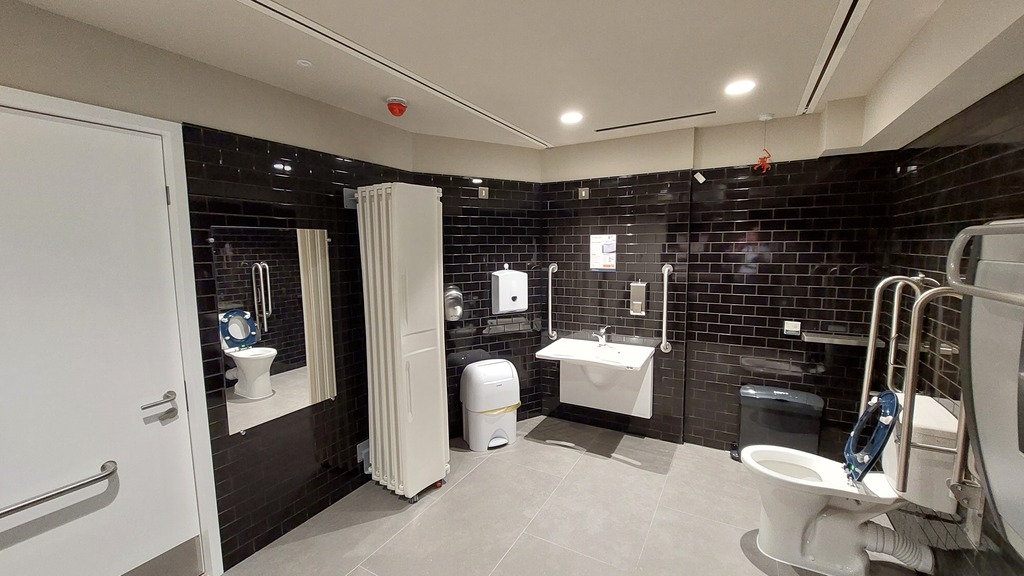
Changing Places accessible toilet with hoist and changing facilities

Plan Accessible Toilets

Accessible toilets deserve to be part of route planning rather than an afterthought, particularly on long days away from accommodation. Standard accessible toilets vary in size and equipment, and not every facility will meet the needs of someone who requires more space, a hoist or an adult-sized changing bench.

The UK has a large network of Changing Places Toilets, which provide additional space and specialist equipment beyond a standard accessible toilet. The Changing Places map can be used to locate registered facilities and can be particularly useful when planning long journeys or full days of sightseeing.

What Can Still Be Difficult?

Accessibility can change unexpectedly during a UK trip. A lift failure may remove the only step-free route through a station, while rain can make cobbles, grass and unpaved paths considerably more difficult to navigate. Historic buildings may also have unavoidable restrictions because alterations are not always possible.

Wheelchair accessibility is also highly individual. A countryside route suitable for an all-terrain mobility scooter may be impractical in a manual wheelchair, while platform lifts and other equipment can have size or weight restrictions. Checking these details against your own mobility requirements is more useful than relying on a general “accessible” label.

Wheelchair user boarding an accessible black cab in London

Is the UK a Good Destination for Wheelchair Users?

The United Kingdom offers wheelchair users an unusually broad range of experiences, from major museums and historic cities to rail journeys, waterways and countryside activities. Its strongest advantage is not that every part of the country is accessible, but that detailed accessibility information and assistance services can make many journeys easier to research in advance.

The challenges are real: old infrastructure, uneven surfaces, lift-dependent routes and differences between transport systems can all affect an itinerary. But by checking the complete journey rather than simply the destination, wheelchair users can build a UK trip that goes well beyond a short list of conventional accessible attractions.

Related posts

Scotty’s Castle in Death Valley, California, with red-tiled roofs and a tower surrounded by desert hills.

Scotty’s Castle: Desert Secrets

Discover Scotty’s Castle, an unexpected desert retreat in California’s Death Valley. Explore the unlikely friendship behind its name, distinctive architecture and ongoing flood recovery. Our guide explains the limited exterior tours currently available, what remains closed, and the practical questions to ask before planning a visit to this Hidden Gem.

Read More »
Angel of Independence monument on Paseo de la Reforma in Mexico City, Mexico, surrounded by modern skyscrapers and trees.

Mexico: Beyond the Beaches

Mexico offers far more than beach holidays. Explore ancient Maya cities, colonial streets, regional food and living traditions, from Mexico City and Puebla to jungle ruins and protected lagoons. Our country guide brings together cultural highlights, remarkable landscapes and practical transport advice to help you plan a varied, manageable journey.

Read More »
Ornate interior façade of Antwerp Central Station, with a clock, gilded decorations and a bird sculpture beneath the glass roof.

Antwerp Central Station

Antwerp Central Station combines monumental architecture with an engineering transformation beneath the city. Explore its historic halls, steel and glass roof, stacked railway levels and modern atrium, then discover how a former terminus became a through station. Our guide highlights what to notice during an unhurried visit.

Read More »
Bruges canal at dusk with boats, a stone bridge and illuminated buildings, setting the scene for an In Bruges film locations guide

In Bruges Film Locations

Bruges becomes part of the story in Martin McDonagh’s dark comedy In Bruges. Follow its filming locations from Markt and the Belfry to canal-side views and the Jerusalem Chapel, with a flexible walking route and practical advice for enjoying the city at your own pace.

Read More »
Channel Tunnel illustration showing Eurostar and LeShuttle trains beneath the English Channel, with Folkestone and Coquelles marked above.

London–Paris via the Channel Tunnel

Discover the engineering behind the Channel Tunnel, from its three-tunnel design to the exhibition in Coquelles and Samphire Hoe’s reclaimed coastline. Explore the story beneath the sea, meet its builders, and see how this connection transformed train travel between London and Paris.

Read More »
St Peter’s Square viewed from the dome in Vatican City

Vatican City

Vatican City brings St Peter’s Basilica, the Vatican Museums and the Sistine Chapel into a remarkable historic setting. Our guide looks at its art, continuing religious life and the work involved in preserving its collections.

Read More »
Scroll to Top