

The Forbidden City in Beijing: Inside China’s Imperial Palace

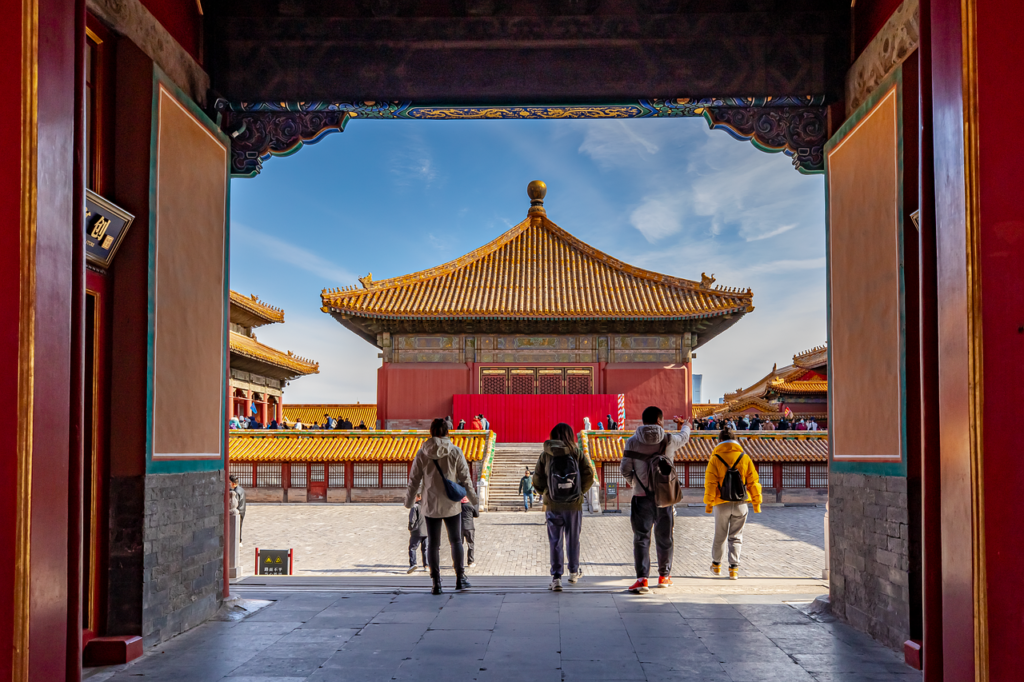
Visitors entering a courtyard of the Forbidden City in Beijing, with a red palace building and golden roof framed by a gateway

Beijing’s Forbidden City is easy to recognise from photographs: red walls, yellow roofs and vast courtyards stretching towards the horizon. Walking through it is a different experience. The scale becomes apparent gate by gate, while the details begin to tell a more complicated story about ceremony, power and daily life behind the palace walls.

Today, the complex is the Palace Museum. For centuries, it was the centre of imperial government and the home of the Ming and Qing emperors. It belongs to the UNESCO-listed Imperial Palaces of Beijing and Shenyang, but its significance is not just a matter of age or size. The Forbidden City shows how an empire expressed its ideas about authority through architecture.

A Palace Built Around Power

Construction began in 1406 under the Ming emperor Yongle, and the palace was completed in 1420. Over the following centuries, 24 Ming and Qing emperors were enthroned here. The complex was designed as a sequence of spaces: visitors moved towards increasingly important buildings, while access to the inner court was once tightly controlled.

That arrangement still shapes a visit. Entering from the south, you pass through monumental gates and open courtyards before reaching the great ceremonial halls. The broad spaces were meant to impress. They make the emperor’s position in the hierarchy visible long before you learn the name of any individual building.

The palace became a museum in 1925, opening this former seat of imperial power to a very different public. Its preservation allows visitors to see not only magnificent buildings, but also the physical order of a court that governed China for centuries.

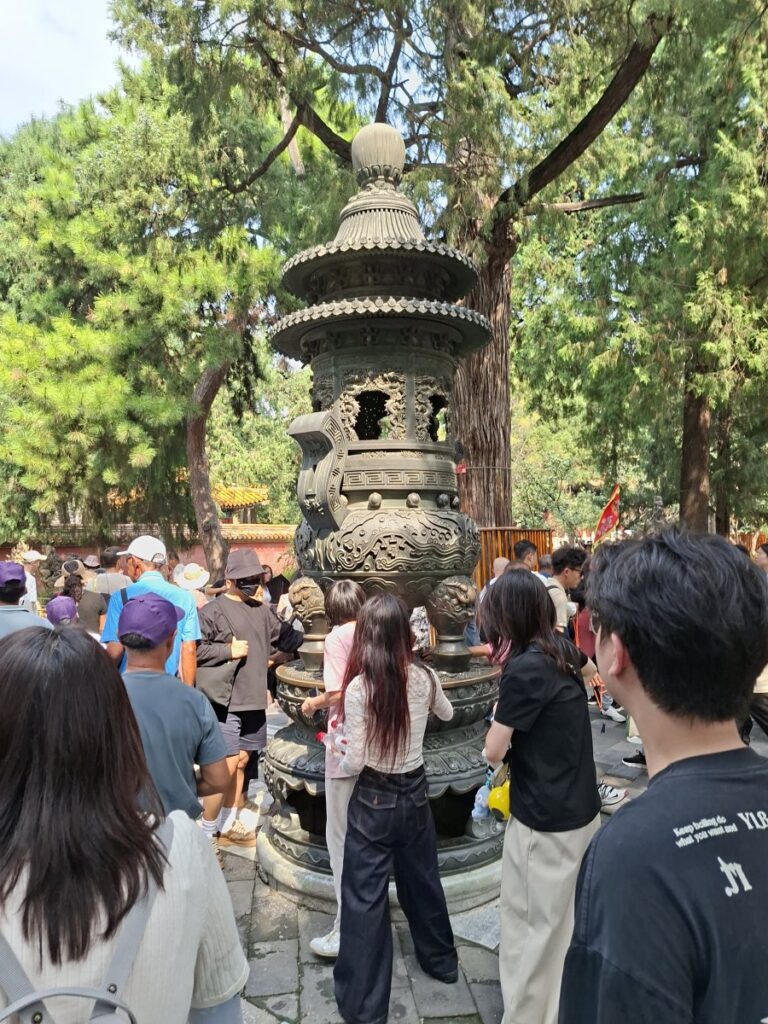
Visitors gather around an ornate ceremonial incense burner beneath the trees at the Forbidden City in Beijing

What to Notice Along the Central Axis

The usual route leads north from the Meridian Gate through the Outer Court. Its three principal halls include the Hall of Supreme Harmony, associated with major imperial ceremonies, followed by the smaller Halls of Central Harmony and Preserving Harmony. Viewed together, they are more revealing than any one hall in isolation: the raised platforms, aligned doorways and repeated courtyards all reinforce the importance of the centre.

Beyond them lies the Inner Court, where the imperial family lived and affairs of state also continued. The Palace of Heavenly Purity and the adjoining buildings bring the story closer to domestic life, although this was hardly an ordinary home. Even private space was organised around rank, ritual and the demands of government.

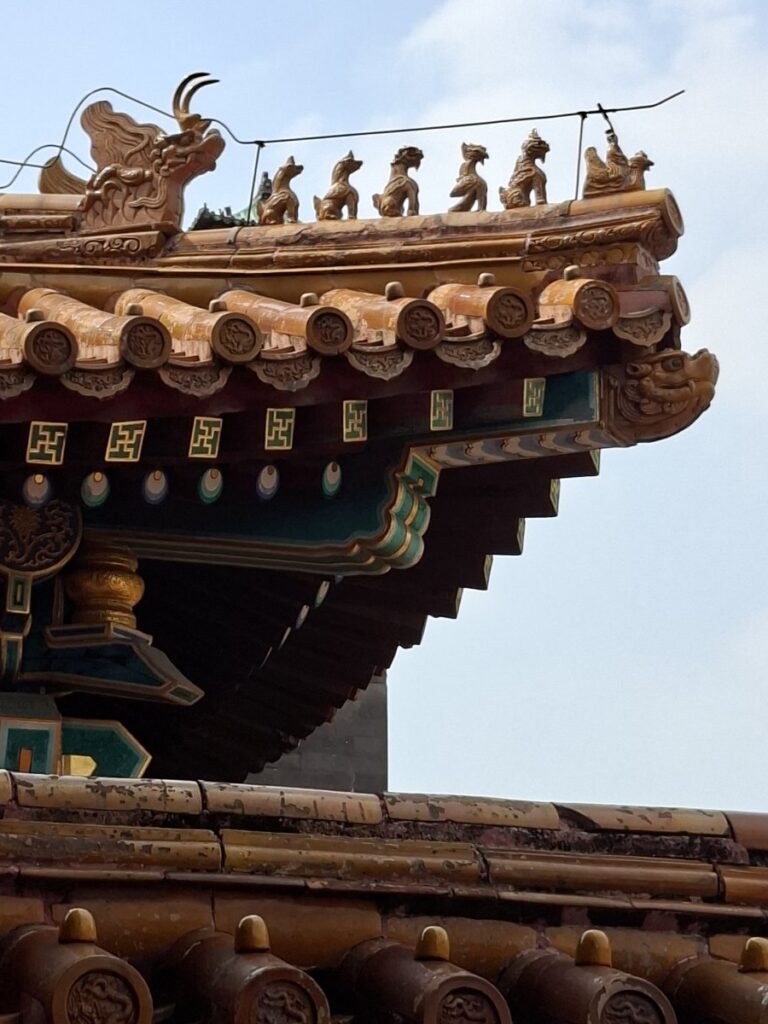
Look beyond the familiar red-and-gold colour scheme. Roof forms, decorative details and the position of each building helped signal status and purpose. The palace rewards visitors who occasionally stop looking straight ahead and pay attention to the smaller courtyards and entrances beside the main route.

 Beyond the Grand Halls

The central axis gives you the clearest sense of the Forbidden City’s design, but it should not be the whole visit if you have time and energy. The eastern and western areas contain former residential compounds, smaller courtyards and museum displays that add texture to the story of life at court.

Check the Palace Museum’s current exhibition information before you go. Galleries and accessible areas can change, and an exhibition that particularly interests you may be a better use of your time than trying to cover every open courtyard. The Treasure Gallery and Gallery of Clocks are separate highlights for visitors interested in objects as well as architecture; check their admission arrangements when booking. A focused route often makes for a better day than an attempt to see everything. This is a large site, and its most memorable moments may come when you have enough time to absorb a quiet side courtyard after the scale of the ceremonial spaces.

Before leaving through the northern gate, make time for the Imperial Garden. After the formal symmetry and broad, exposed courtyards of the palace, its pavilions, rockery and old trees feel like a change of pace. Look for the “Interlocked Cypress”: according to the Palace Museum, its unusual shape was created by joining branches from two trees. It is a small but telling detail in a garden where even the appearance of nature reflects careful design.

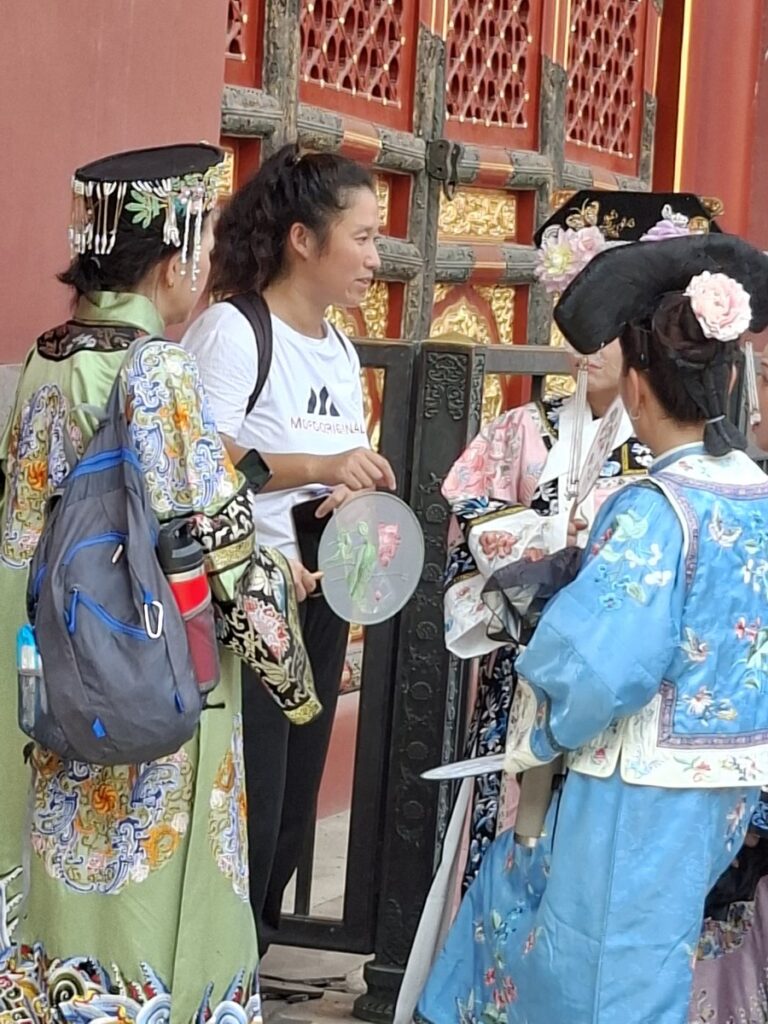
Visitors in colourful traditional-style clothing beside the red palace walls of the Forbidden City in Beijing

An Imperial Setting in Present-Day Beijing

The palace is no longer a place reserved for the court. Alongside visitors studying its history, you may see people taking photographs in traditional-style clothing against the red walls. It is an eye-catching reminder that the Forbidden City remains part of Beijing’s living cultural imagination, not simply a monument sealed in the past.

That modern interest sits beside the museum’s responsibility to protect fragile historic buildings and collections. Enjoy the atmosphere, but follow the rules on photography, restricted areas and the use of equipment. A good visit leaves room both for the pleasure of being there and for respect for the place itself.

Planning Your Visit

Book before you go. The Palace Museum does not sell same-day admission tickets. International visitors can use the official English Palace Museum website to check availability and book with their passport details. Bring the original passport used for the reservation, and confirm the current booking window, opening hours and any special-gallery arrangements before your visit. The museum normally closes on Mondays, except on some public holidays.

Understand your admission period. Tickets are booked for a morning or afternoon entry period. This determines when you may enter, not how long you can spend inside; once admitted, you can explore until the museum closes. Check the entry conditions on your reservation and do not aim to arrive near the end of your admission period.

Allow time for the queue. A reserved ticket does not mean immediate entry. On our weekday visit, we waited more than two hours in direct sun before getting inside. Your wait may be shorter, but bring water and sun protection, and leave plenty of time before any plans later that day.

Plan for a south-to-north walk. Visitors enter through the Meridian Gate on the southern side. At the end of the visit, they can leave through the Gate of Divine Prowess to the north or the East Prosperity Gate to the east. Check your onward route before arriving; the exit is not where you entered.

Give the palace at least half a day. There are long distances between buildings, exposed courtyards and plenty worth seeing beyond the central route. Comfortable shoes and a realistic pace will matter more than an ambitious checklist. If steps, uneven surfaces or long walks are a concern, consult the museum’s visitor map and barrier-free route information before choosing your route.

If Beijing is part of a longer trip, our China travel guide can help you put the capital in the context of the country’s other destinations.

Decorative animal figures line the corner of a tiled roof at the Forbidden City in Beijing

Is the Forbidden City Worth the Effort?

Yes, especially if you give it more than a hurried walk down the middle. The Forbidden City can be crowded and physically tiring, but few places make the relationship between architecture and political power so tangible. Its grand halls explain how emperors presented themselves; its quieter spaces help you imagine the people who lived and worked behind that public image.

For a wider view of China’s monumental history, pair this visit with our guide to the Great Wall of China. The two places tell very different stories: one about the organisation of an imperial court, the other about the long and varied history of China’s northern defences.

Related posts

Boats trading produce at a floating market in the Mekong Delta, Vietnam

Mekong River Cruise

Follow a Mekong cruise through Vietnam and Cambodia, from delta waterways to Phnom Penh. Learn how route direction, changing water levels and transfers to Siem Reap affect the journey, alongside what to expect from shore excursions.
Read More »
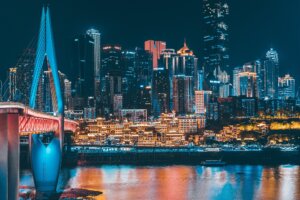
Chongqing skyline at night in China, with an illuminated bridge, waterfront buildings and reflections on the river

China: Beyond the Famous Sights

China’s imperial landmarks, contemporary cities and regional traditions offer contrasting journeys. Our guide introduces Beijing, Shanghai, Chengdu and Yangshuo, with practical considerations for train travel, digital payments, accessibility and choosing a route that feels manageable.

Read More »
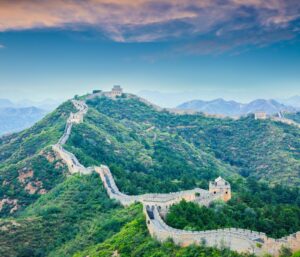
The Great Wall of China winding across green mountain ridges, with watchtowers along the route

Journey Through Time and Stone

The Great Wall offers very different experiences at its sections near Beijing. Compare the character of Badaling, Mutianyu and Simatai, including transport, walking conditions and the limits of routes described as accessible.

Read More »
Scroll to Top