
Wheelchair Accessible Italy: What to Expect Before You Travel

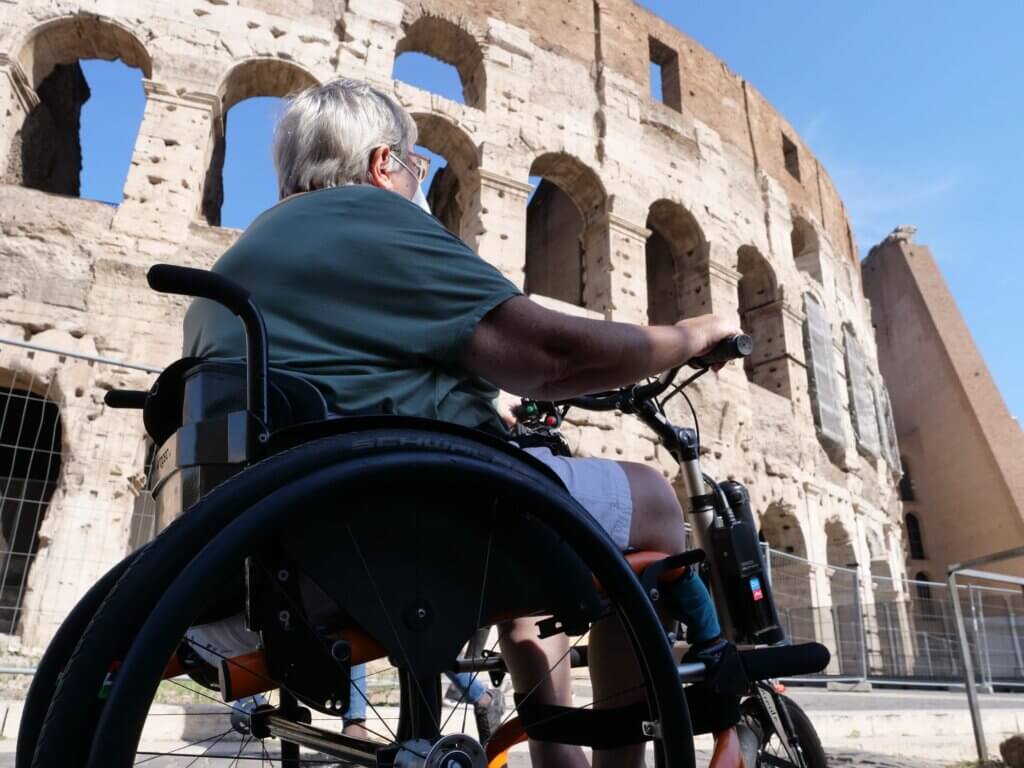
Wheelchair user visiting the Colosseum during an accessible trip to Italy

How wheelchair accessible is Italy? The answer depends greatly on where you go and how you plan your journey. Italy can be a rewarding destination for wheelchair users, but it is not a barrier-free one. High-speed trains, assistance services and improved access to many major attractions make travelling easier than Italy’s historic streets might suggest.

Accessibility can vary considerably even within the same city. A museum may have an accessible entrance and lifts while the route leading to it involves cobblestones, steep streets or difficult kerbs. This guide focuses on those practical differences – and on the tools that can help you plan around them.

Italy’s greatest accessibility problems are often not inside its famous attractions. They are between them.

Rome’s sampietrini paving stones can be tiring in a manual chair, while historic centres elsewhere may bring narrow pavements, high kerbs, steep streets and entrances with one or two steps. Hill towns need particular attention: a short distance on a map may hide a considerable gradient.

Accommodation can be equally unpredictable. An “accessible” filter does not tell you whether access from the street is step-free, the lift is wide enough, the bathroom has a roll-in shower or there is enough space beside the bed. That is why the whole route matters more than individual accessibility labels.

You can also explore our Wheelchair Accessible Travel section for practical accessibility guides to other destinations.

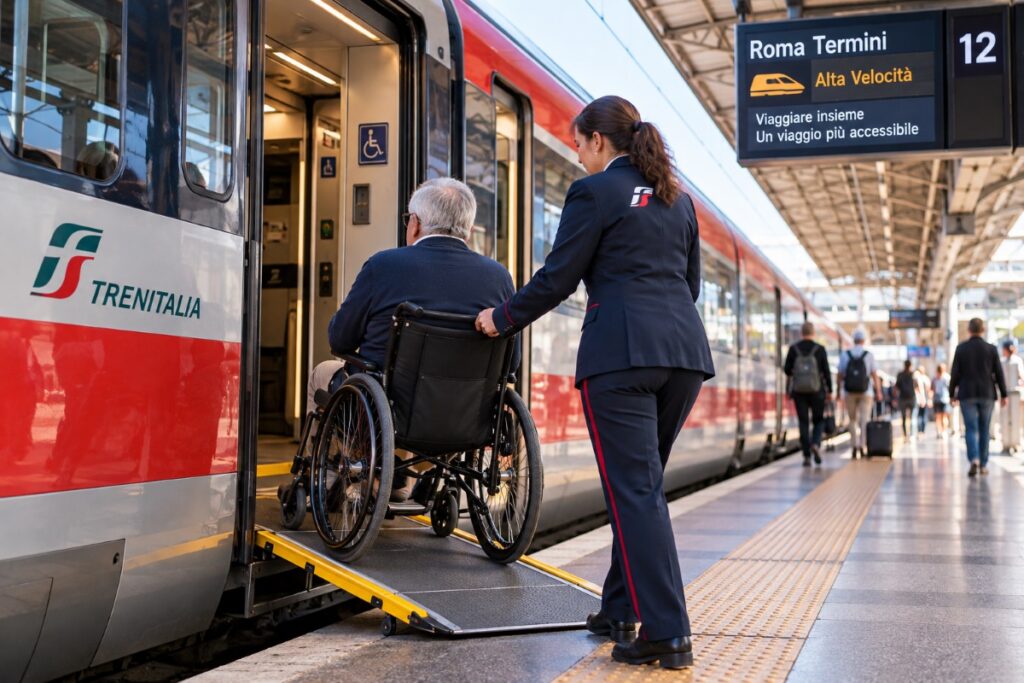
Wheelchair user boarding a train with assistance at an Italian railway station

Getting Around Italy

Travelling by Train

For journeys between major cities, rail can be one of the easiest options. High-speed services connect Milan, Florence, Rome, Naples and other major destinations, while Trenitalia’s Frecciarossa trains provide designated wheelchair spaces and accessible toilets.

RFI’s Sala Blu network coordinates assistance at more than 380 stations, including help reaching, boarding and leaving trains.

The old advice that assistance must always be booked 24 hours ahead is no longer accurate. Notice periods vary by station and service, with shorter notice possible in some locations. If assistance is essential, arranging it in advance remains the safer choice.

Airports and Assistance

Passengers with disabilities or reduced mobility are entitled to assistance at EU airports, including those in Italy. Italy’s civil aviation authority, ENAC, recommends requesting the service through your airline, travel agent or tour operator at least 48 hours before departure. You may see the term ADR Assistance at Rome Fiumicino and Ciampino. ADR is Aeroporti di Roma, the operator of those airports – it is not the name of Italy’s nationwide assistance service.

Ferries and Lake Transport

Ferries are useful for reaching Sicily and Sardinia and for exploring the Italian lakes.

On Lake Garda, Lake Como and Lake Maggiore, Navigazione Laghi reports that most of its fleet can accommodate passengers with reduced mobility. Newer vessels generally provide better access, while older ones may have limitations. Even the angle of the boarding ramp can change with the water level – a potentially important detail for power-chair users.

What to Expect in Italy’s Most Popular Destinations

Rome

Rome combines increasingly accessible major attractions with challenging historic streets.

At the Colosseum, much of the first level is accessible and a lift provides access to the second. The Vatican Museums have an accessible itinerary, lifts, accessible toilets and free wheelchair loans, although some areas cannot accommodate larger electric wheelchairs or mobility scooters.

Between the attractions, cobblestones, uneven surfaces and busy crossings can make apparently short journeys considerably more demanding.

Florence

Florence’s compact, mostly flat historic centre makes it one of the easier major Italian cities to navigate. The Galleria dell’Accademia has an accessible route, lift and accessible toilets, while the Uffizi also provides facilities for visitors with reduced mobility. At the cathedral complex, the cathedral itself is accessible, but Brunelleschi’s Dome and Giotto’s Bell Tower cannot be reached by lift. The Opera del Duomo Museum, by contrast, has lift access. This makes Florence particularly suitable for travellers interested in museums and the historic centre rather than its famous panoramic climbs.

Venice

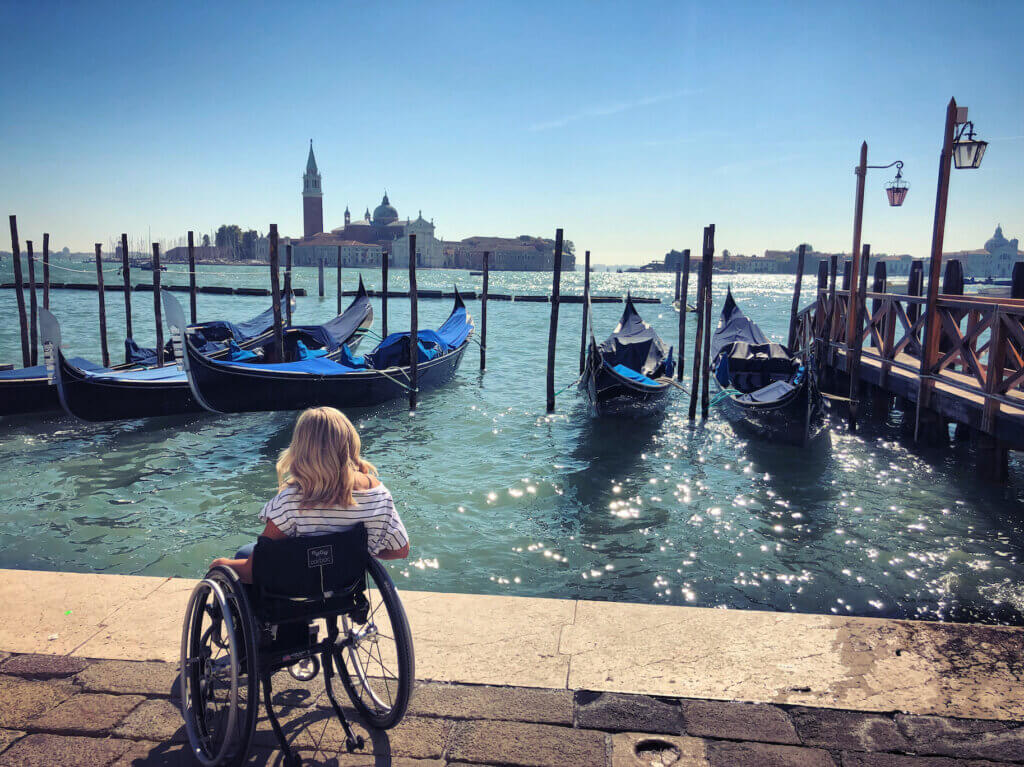
Venice is possible with a wheelchair, but its bridges remain a fundamental obstacle. The ACTV vaporetto network makes a significant difference by allowing many bridges to be bypassed. Under current ACTV rules, wheelchair users and European Disability Card holders can buy a €1.50 ticket valid for 75 minutes, while a companion travelling with a wheelchair user can travel free. Rather than trying to follow a conventional walking itinerary, choose the places you want to see and use Venice’s accessible-route information together with the vaporetto network to connect them.

Murano can also be a worthwhile addition to a Venice itinerary. The island has an official accessible route, and its glassmaking heritage – including the accessible Glass Museum – makes it an interesting side trip from Venice.

Wheelchair user overlooking gondolas and the Venetian lagoon in Venice, Italy

The Italian Lakes

The Italian lakes can offer a welcome contrast to Italy’s historic city centres. Several towns on Lake Garda and Lake Como have relatively level waterfront promenades, while ferries can reduce the need to cover long distances on land. Accessibility can change quickly away from the waterfront, however: some villages climb steeply uphill and older centres may have steps or narrow lanes.

For an easier day, it makes sense to concentrate on lakeside areas and use ferry connections between towns rather than assuming that short distances on a map will also mean easy routes.

Museums, Tickets and Disability Discounts

Visitors with disabilities are eligible for free admission to Italian state museums, monuments and archaeological sites, with a companion also eligible under specified conditions. The European Disability Card is among the accepted forms of documentation. Private attractions and municipal museums may have different policies, so these benefits do not apply everywhere. It is also worth separating free admission from physical accessibility: an historic monument may offer free entry while some sections remain unreachable. For important sights, the attraction’s own accessibility information is therefore more useful than relying on the admission policy alone.

Planning a Wheelchair Accessible Italy Trip

Rather than simply telling you to “check accessibility”, these are the resources worth using:

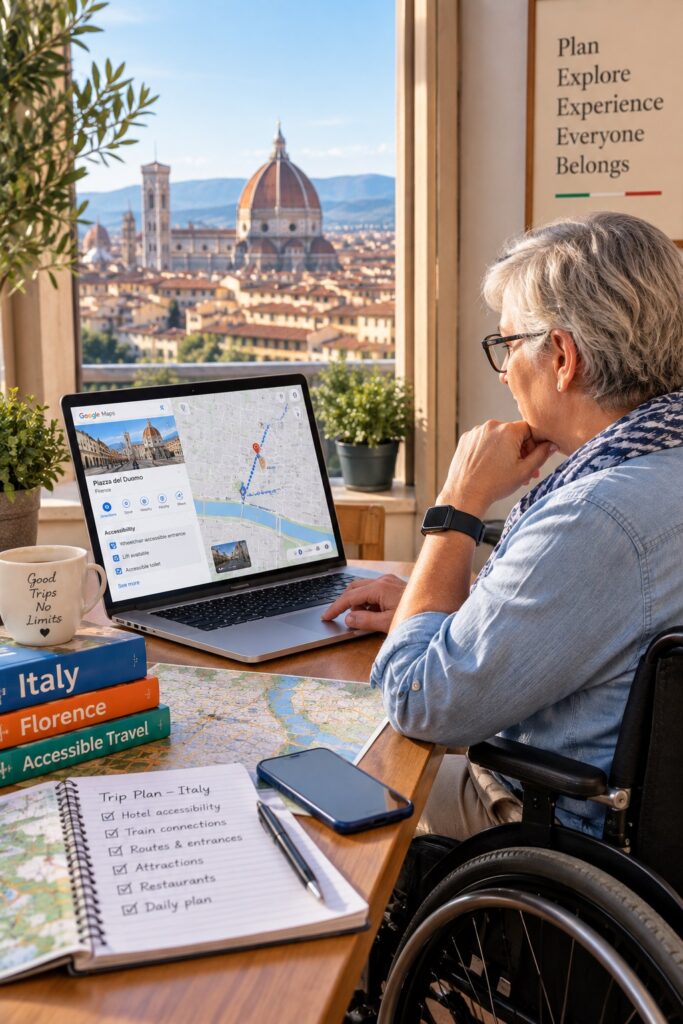
  • Google Maps and Street View: inspect slopes, surfaces, kerbs, entrances and the route between your hotel, transport and attractions.
  • RFI / Sala Blu: check station assistance and booking requirements for rail journeys.
  • Official attraction websites: look for accessible entrances, lifts, toilets and areas that cannot be reached.
  • ACTV and Venice accessibility information: combine vaporetto routes with accessible pedestrian routes to avoid unnecessary bridges.
  • Navigazione Laghi: check accessibility information for services on Lakes Garda, Como and Maggiore.

For accommodation, don’t stop at an “accessible” label. If something is essential, ask for measurements or photographs of the entrance, lift, bedroom and bathroom.

A useful way to plan each sightseeing day is:

hotel → transport → route → attraction entrance → accessible toilet → return route

Power-chair users should also check their charger. Italy has a 230V/50Hz electricity supply and Type C, F and L sockets. If your charger accepts 100–240V, normally only the appropriate plug adapter is required.

Final Verdict

Italy is not barrier-free. Historic streets, bridges, hills and old buildings remain genuine obstacles, and the difficulty can vary considerably even within the same city.

At the same time, high-speed rail, station assistance and improved access to many major museums and monuments make much of Italy achievable with good preparation.

The most useful approach is to plan route by route rather than city by city. An accessibility label tells you something about a destination; knowing how you will actually get there tells you much more.

Related posts

Wheelchair user boarding an accessible black cab in London

The Accessible UK

Plan wheelchair travel across the UK with guidance on transport, attractions and historic places. From London and the rail network to countryside visits, this guide covers accessibility resources, Changing Places toilets and practical steps that can make a trip easier to organise.

Read More »

Accessible France by Wheelchair

Historic towns and older attractions can make wheelchair travel in France challenging. This guide looks at accessible transport, railway assistance, accommodation and major sights, with practical advice on accessibility and what to consider before your journey.

Read More »
Wheelchair user entering the Knights’ Halls in Akko via an accessible ramp

Holy Land: Accessible Travel Guide

Israel offers many accessible travel options, although conditions vary between destinations. Modern transport can be relatively straightforward, while historic areas require more planning. This guide looks at Jerusalem, Tel Aviv and beyond, including transport and attractions.

Read More »
Scroll to Top