



China Travel Guide: Choosing Where to Go and How to Prepare

Chongqing skyline at night in China, with an illuminated bridge, waterfront buildings and reflections on the river

China can offer several very different journeys: imperial palaces and ancient city walls, contemporary skylines and high-speed railways, mountain landscapes, regional food traditions and communities shaped by distinctive ways of living. The challenge is choosing which of these experiences belong together in one trip.

Beijing, Shanghai, Chengdu and the countryside around Guilin reveal different sides of the country. Distances between them matter, and adding another destination can mean sacrificing time to understand the places already on your itinerary. This China travel guide helps you choose a manageable route, look beyond the best-known photographs and prepare for the practical differences that shape everyday travel.

Basic Facts at a Glance

  • Capital: Beijing
  • Region: East Asia
  • Population: Approximately 1.4 billion
  • Official language: Standard Mandarin Chinese; many regional languages and varieties are also spoken
  • Currency: Renminbi, usually expressed in yuan (CNY or RMB)
  • Time zone: China Standard Time, UTC+8

This guide focuses on mainland China

If you include Hong Kong or Macao, check their entry requirements separately and confirm what crossing those borders means for your permission to enter mainland China again. Regional differences are central to planning. Climate, cuisine, architecture and travel distances change substantially across the country, so choosing your destinations first is more useful than looking for a single “best time to visit China.”

Choosing Your China Route

Start with the experiences you most want to have, then connect the destinations that provide them. A first visit does not need to include every famous landmark to feel varied.

Beijing and Shanghai provide a clear contrast between imperial and contemporary urban China. Xi’an adds another historical perspective through the Terracotta Army and the old city. Chengdu introduces Sichuan’s food culture and panda-related visits, while a landscape destination changes the pace of the journey.
For a first trip of around two weeks, we would usually begin with three or four bases rather than a long chain of short stays. This is a planning suggestion, not a fixed rule: the right number depends on your transport connections, energy and interests. Count usable sightseeing days rather than hotel nights, because arrival and departure can consume much of a short stay.


Your main interestPlaces to considerWhat to keep in mind
Imperial history and major monumentsBeijing and Xi’anLarge sites, substantial walking and advance planning
Contemporary cities, architecture and museumsShanghai, with a nearby town or cityBalance major attractions with neighbourhood exploration
Pandas, regional food and urban daily lifeChengduChoose the panda facility carefully and allow time beyond it
River scenery and limestone landscapesGuilin and YangshuoCheck the location of your accommodation and local transfers
Dramatic mountain sceneryZhangjiajie or HuangshanWeather, steps and the complete visitor route matter
Communal architecture and regional heritageFujian’s tulou areasAllow for travel beyond the main railway stations

Looking Beyond the Familiar Photographs

China’s famous sights become more interesting when you understand what you are looking at. In Beijing, the Forbidden City is more than a sequence of red buildings and golden roofs. Its gates, courtyards and central axis expressed imperial hierarchy through the arrangement of space. Our guide to the Forbidden City in Beijing explains what to notice along the route and how to prepare for the visit. The Great Wall also rewards a more specific choice. Different sections offer different terrain, transport arrangements and historical details. Our Great Wall of China guide compares visitor experiences and explains why planning the ascent matters as much as planning the journey from Beijing.

Beyond the best-known monuments, the Fujian Tulou offer another way to understand Chinese architecture. These large earthen residential buildings reveal how construction, communal living and defence were brought together. Their interest lies in how people organised life within them, rather than simply in their unusual shapes.

Natural landscapes deserve the same attention. The limestone scenery around Guilin and Yangshuo differs geologically from the sandstone pillars of Wulingyuan, near Zhangjiajie. Choose between them according to the experience you want—river landscapes, countryside outings or mountain viewpoints—and the routes you can comfortably manage.

When to Visit China

Spring and autumn are useful starting points for many itineraries, but conditions vary by region and elevation. A comfortable day in one city does not tell you what to expect at a mountain destination or several hundred kilometres farther south.

For city sightseeing, consider how much time you will spend outdoors and how well you cope with heat, humidity or cold. For mountain areas, visibility and weather can affect the experience as much as temperature. A viewpoint that looks spectacular in a photograph may be hidden by cloud when you arrive, so avoid making one weather-dependent outing the only reason for a long detour.

Check the Chinese public-holiday calendar before booking transport and accommodation. National Day in early October and the Spring Festival period can bring heavy domestic travel demand. Mild autumn weather does not automatically mean quiet attractions.

Build some flexibility into the itinerary. A spare half-day can help you respond to rain, fatigue or a changed booking without losing an experience you particularly wanted.

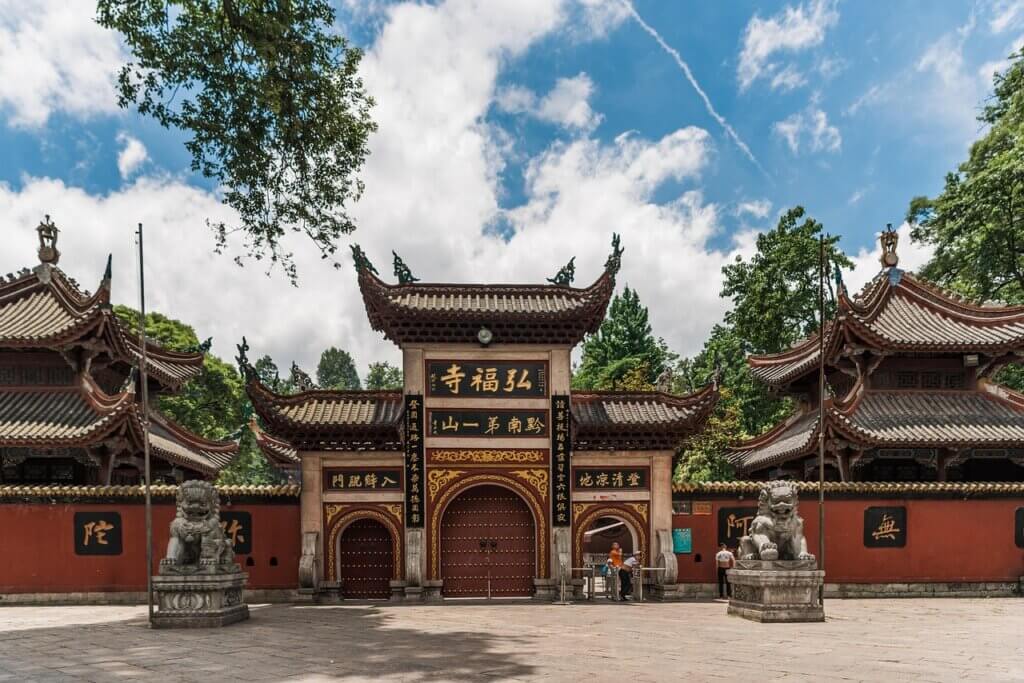
Traditional Chinese temple entrance with ornate tiled roofs, stone guardian lions and trees beneath a partly cloudy sky

Food, Tea and Everyday Culture

Eating in China is an opportunity to notice regional differences. Beijing roast duck, Sichuan hotpot and Cantonese dim sum belong to different culinary traditions, so moving between regions also changes what appears on the table.

In Chengdu, food can be a reason to slow down rather than an activity squeezed between attractions. Sichuan dishes may combine chilli heat with the tingling sensation of Sichuan pepper, and ordering a milder option can make an unfamiliar meal more enjoyable. Elsewhere, dumplings, noodles, steamed dishes and regional vegetables provide many ways to explore beyond the foods already familiar from restaurants at home.

Shared dishes can make meals especially interesting for couples or small groups. Order gradually, check portion sizes and use a translation tool when the menu is unclear. If you have an allergy or strict dietary requirement, carry a written explanation in Chinese; a dish name alone may not reveal its ingredients or cooking stock.

Leave time for everyday settings as well as celebrated restaurants. Beijing’s hutong lanes, neighbourhood markets and Chengdu’s teahouses provide a different perspective from monumental sites. Some areas are strongly oriented towards visitors, but looking at how people shop, eat and spend time together can give a journey greater depth.

Getting Around Without Overloading the Trip

China’s railway network makes many multi-city routes practical, but compare the complete journey rather than the train’s advertised travel time. Transfers to the station, security checks, boarding and travel from the arrival station to your hotel all belong in the calculation. The official China Railway 12306 English website provides booking services for foreign passport holders. Enter your passenger details carefully and travel with the original passport used for the reservation. Check the exact station name: large cities may have several railway stations serving different routes.

Traveller checking his smartphone on a railway platform with a modern passenger train behind him

High-speed trains are often worth comparing with flights between major cities. Flying may make more sense over longer distances, while rail can provide a convenient connection without an airport transfer. Choose according to the route and timetable rather than assuming one mode is always better.

Within cities, combine metro journeys with walking and occasional taxis or ride-hailing services. A station close to your hotel is useful, but check the walking distance to the entrance and the facilities you need. Save your accommodation’s name and address in Chinese so that you can show them to a driver or ask for help.

Payments, Internet and Practical Preparation

China’s everyday digital systems deserve attention before departure. Preparing your phone, payment methods and essential information can remove uncertainty from the first days of the trip.

Alipay and WeChat Pay support linking eligible international bank cards, although verification, fees and available services can vary. Follow the current official payment guidance for overseas visitors, complete the required setup and keep another payment option available. Do not assume that direct payment with a foreign card will work everywhere you visit.

Internet access also differs from what many travellers use at home. Some familiar services, including Google, Facebook and YouTube, are blocked in mainland China. Before travelling, arrange a way to contact family, save essential documents offline and check whether your intended translation and navigation tools will function. Ask your mobile provider about coverage and restrictions rather than assuming that every SIM or roaming package behaves the same way.

Entry permission depends on your passport, purpose of travel and itinerary. Visa exemptions and transit arrangements have specific conditions; check the National Immigration Administration’s current guidance and the relevant Chinese embassy before booking a trip around them. Carry your passport, protect your belongings in crowded places and check your government’s current travel advice. Be cautious about unsolicited invitations to tea tastings or other venues, where an apparently friendly encounter can end with an unexpected bill. The official safety guidance for China explains this and other practical risks.

Accessibility and a Comfortable Travel Pace

Accessibility needs to be assessed route by route. A modern hotel or a cable car at an attraction does not establish whether the entire visit is suitable for someone using a wheelchair or managing limited mobility.

Ask about the complete journey: transport, the approach to the entrance, queues, boarding arrangements, gradients, steps, toilets and the route back. Large palace complexes can involve long distances across courtyards, while mountain attractions may still require substantial walking between transport facilities and viewpoints.

For accommodation, request specific details about entrances, lifts and bathrooms rather than relying on a general “accessible” label. For rail journeys and guided excursions, arrange assistance in advance where needed and explain your requirements clearly.

Wheelchair user accompanied by an older man along a paved path lined with flowering trees

A comfortable pace benefits many travellers, regardless of whether they need formal assistance. Plan one demanding visit in a day, choose accommodation that reduces unnecessary transfers and keep room for meals and rest. China offers enough variety that you do not need to make every day physically ambitious.

The most rewarding route is one you can enjoy with attention: enough time to understand a palace, notice the skill behind a craft, explore a neighbourhood or stay with a landscape beyond the first photograph. Choose a few experiences that matter to you, prepare for their practical requirements and let them give the journey its shape.

Related posts

The Forbidden City in Beijing

Beijing’s Forbidden City was the ceremonial centre of imperial China. Follow its south-to-north visitor route, understand the spaces beyond the main courtyards, and prepare for advance booking, queues and a substantial walk.


Read More »
Boats trading produce at a floating market in the Mekong Delta, Vietnam

Mekong River Cruise

Follow a Mekong cruise through Vietnam and Cambodia, from delta waterways to Phnom Penh. Learn how route direction, changing water levels and transfers to Siem Reap affect the journey, alongside what to expect from shore excursions.

Read More »
The Great Wall of China winding across green mountain ridges, with watchtowers along the route

Journey Through Time and Stone

The Great Wall offers very different experiences at its sections near Beijing. Compare the character of Badaling, Mutianyu and Simatai, including transport, walking conditions and the limits of routes described as accessible.

Read More »
Scroll to Top