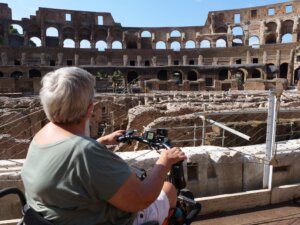
Practical Planning for Wheelchair Users
Check Your Charger Before Travelling
The United States generally uses 120V/60Hz electricity and Type A and B plugs, but this does not automatically mean that a European power-wheelchair charger requires a voltage transformer. Many modern chargers accept a broad input range such as 100–240V, 50/60Hz, in which case a suitable plug adapter may be all that is needed.
Before travelling, check the input information on the charger itself or consult the manufacturer’s specifications. If the charger does not support the U.S. voltage and frequency, contact the wheelchair or charger manufacturer for advice rather than buying a transformer based on wattage alone. This is worth checking well before departure, particularly if the wheelchair is essential for independent mobility throughout the trip.
Distances Can Be Deceptive
California is larger than many visitors expect, and distances that look manageable on a map can translate into substantial travel days. Trying to combine San Francisco, Yosemite, Los Angeles and San Diego in a short itinerary can mean spending a surprising amount of the holiday moving between destinations rather than enjoying them.
For wheelchair users, those transfers may also involve arranging an adapted vehicle, confirming accessible transport or allowing extra time for rest stops and equipment. Fewer bases and slightly longer stays can therefore make the trip both easier and more enjoyable, especially when accessible services need to be booked in advance.
Check the Terrain, Not Just the Attraction
An attraction described as accessible does not necessarily mean that the entire journey to and around it will be straightforward. A museum may have a step-free entrance while the surrounding streets are steep, a national park trail may be paved but have demanding gradients, and a beach may offer an accessible promenade without providing a practical route across the sand.
When researching a destination, look at the complete journey rather than only the accessibility statement on the attraction’s website. Parking or public transport, the approach to the entrance, gradients and surfaces, accessible toilets and the route through the site can all affect the experience. Google Street View can also be useful for checking hotel entrances, pavements, kerbs and the terrain immediately around an attraction before travelling.
For more destination-specific planning, our Wheelchair Accessible Travel guides look at these practical differences in other destinations too.
What Can Still Be Difficult?
Accessibility standards cannot remove California’s geography, and steep gradients, sand, uneven natural surfaces and long distances can still determine whether a particular route is practical. Older buildings and historic districts may require more planning than modern attractions, while temporary lift outages, construction or seasonal conditions can change an otherwise accessible route. These limitations do not necessarily make a destination unsuitable, but they are worth identifying before they become unexpected obstacles during the trip.
Most importantly, wheelchair accessibility is individual. A route that works comfortably with a powered wheelchair may be demanding independently in a manual chair, while transfer requirements can make an attraction practical for one visitor but unsuitable for another. Treating accessibility information as a starting point rather than a simple yes-or-no label makes it easier to build an itinerary around your own requirements.