
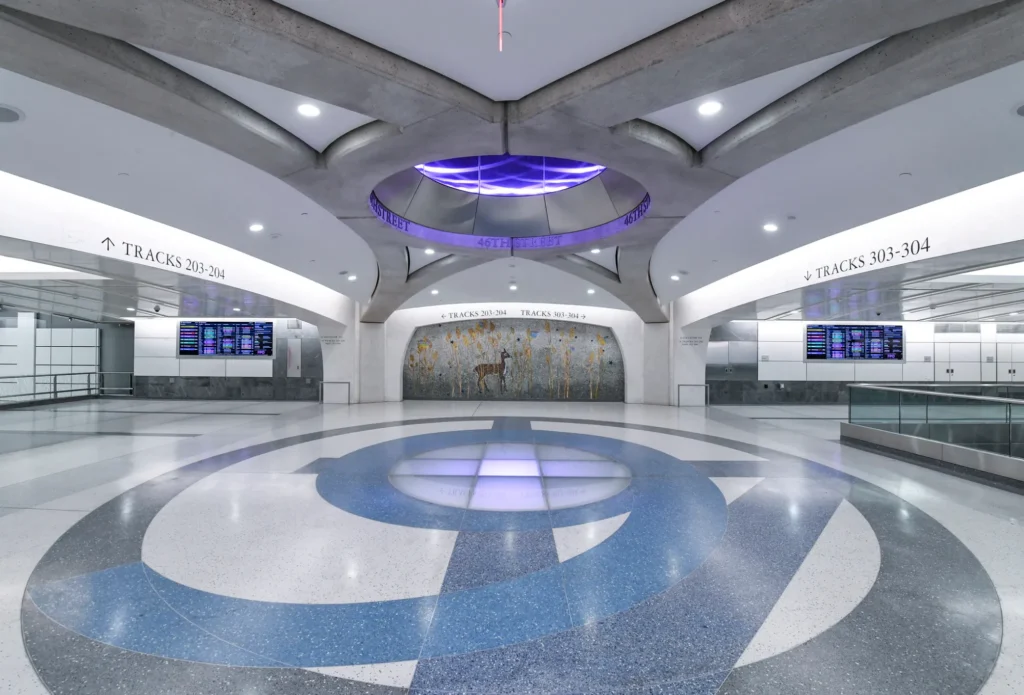

Grand Central Madison concourse with curved arches, track signs and a mosaic artwork.

Grand Central Madison: How New York Built a Railway Beneath a Railway

Grand Central Madison lies below one of New York’s best-known buildings, but its scale is easy to underestimate from above. Opened in 2023, the new Long Island Rail Road terminal brought trains directly to Manhattan’s East Side. To make that possible, engineers had to create tunnels and immense station spaces beneath existing transport infrastructure and the buildings of Midtown. The result is more than a technical addition to Grand Central. Long escalator journeys lead passengers into a new sequence of concourses and platforms, with major works of public art along the way. Grand Central Madison is worth exploring both for the difficulty of its construction and for the experience of moving through the finished station.

To explore the older station’s architecture and the railway beneath it, read our guide to Grand Central Terminal.

Why Build Another Terminal Below Grand Central?

For generations, Long Island Rail Road passengers arriving in Manhattan used Pennsylvania Station on the West Side. Travellers heading to East Midtown then needed another connection. The East Side Access project created a route into Grand Central Madison, giving LIRR passengers a direct arrival point on the other side of Manhattan.

The scheme extended well beyond the new station. It involved tunnels, track connections and changes elsewhere on the LIRR network. Beneath Midtown, the task was especially demanding: the new railway had to fit around existing tracks, utilities and building foundations while transport and city life continued above it.

This is what distinguishes Grand Central Madison from a station built on an empty site. Engineers were adding a substantial new layer to a city whose underground space was already crowded.

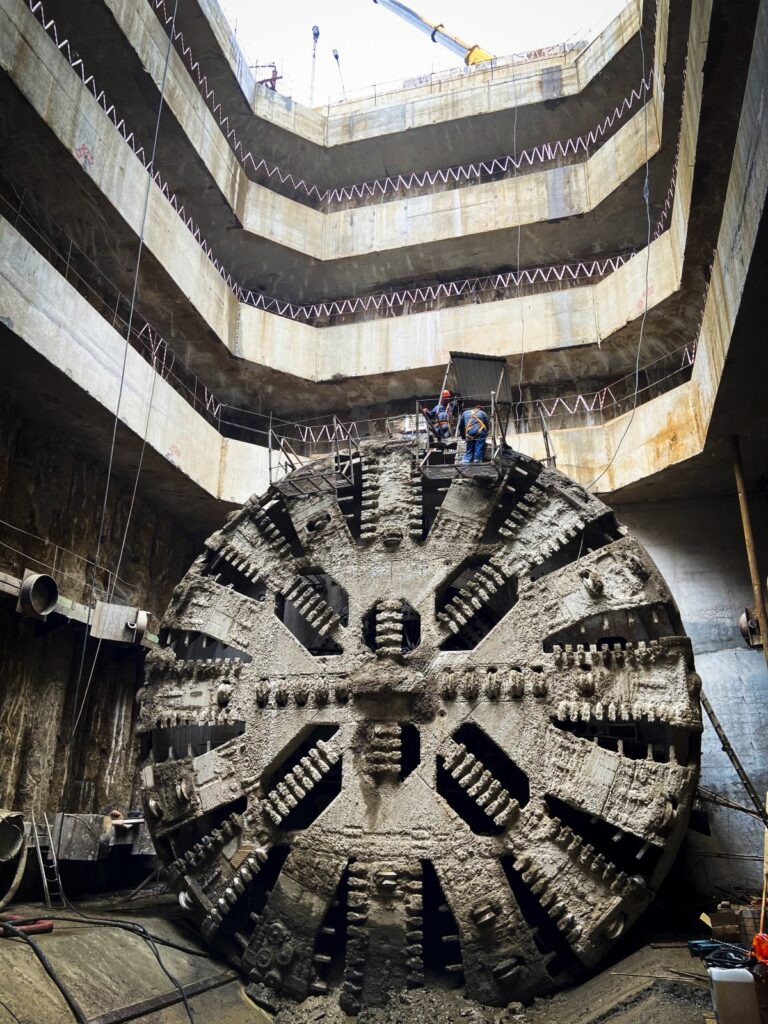
Large tunnel boring machine cutter head inside an underground construction shaft.

Two Machines Beneath Manhattan

Two hard-rock tunnel boring machines, each about 22 feet (6.7 metres) in diameter, excavated approximately 25,000 feet (7.6 kilometres) of tunnel beneath Manhattan between 2007 and 2013. Rotating cutter discs broke through the rock, and conveyor systems carried the excavated material away.

The machines worked through difficult geology beneath streets lined with buildings. As they advanced, crews had to monitor the ground and the structures above. The tunnels were only one part of the work: the machines could follow a defined route, but they could not simply carve every broad station cavern and connecting space to its finished shape.

That called for a combination of methods. Crews used roadheaders, machines with rotating cutting heads that remove rock in controlled sections. Elsewhere, they drilled patterns of holes and used carefully sequenced explosive charges. The choice depended on the shape of the space being built and what lay nearby.

Blasting Without Stopping the Trains

The station caverns presented a particularly unusual challenge. They had to be excavated below an operating railway, with limited room for disruption above. Small explosive charges were fired in planned sequences, while seismic instruments measured the resulting vibrations. The project’s engineering team reports that 2,365 blasts were carried out without causing a Metro-North train cancellation or delay. That figure captures more than the precision of each blast. It reflects the scheduling and coordination needed to work beneath active tracks day after day.

Once rock had been removed, crews still had to create durable station spaces. Waterproofing, rock supports and concrete linings transformed the excavated caverns into areas that could house platforms and passenger routes. The finished surfaces conceal much of the staged work behind them.


Building a Station With Almost No Surface Space

Excavation was only part of the logistical problem. A project of this size needs a constant flow of equipment, materials and workers, but Midtown offered little room for a conventional construction yard beside the site. The team made extensive use of the railway itself. Materials travelled through tunnels and on railcars to the underground work area. According to the project’s engineering account, deliveries ranged from structural components and finishes to the practical equipment needed to run the worksite.

This is one of Grand Central Madison’s most distinctive engineering stories. The new station was built beneath a working transport network, and that network also helped supply its construction.

Another unusual remnant lies farther south beneath Park Avenue: a substantial part of a tunnel boring machine was left underground after its work ended. Bringing every heavy component back through the confined underground route would have been a major operation. The part that remained is invisible to passengers, but it is a reminder of the extraordinary size of the equipment used below Manhattan.

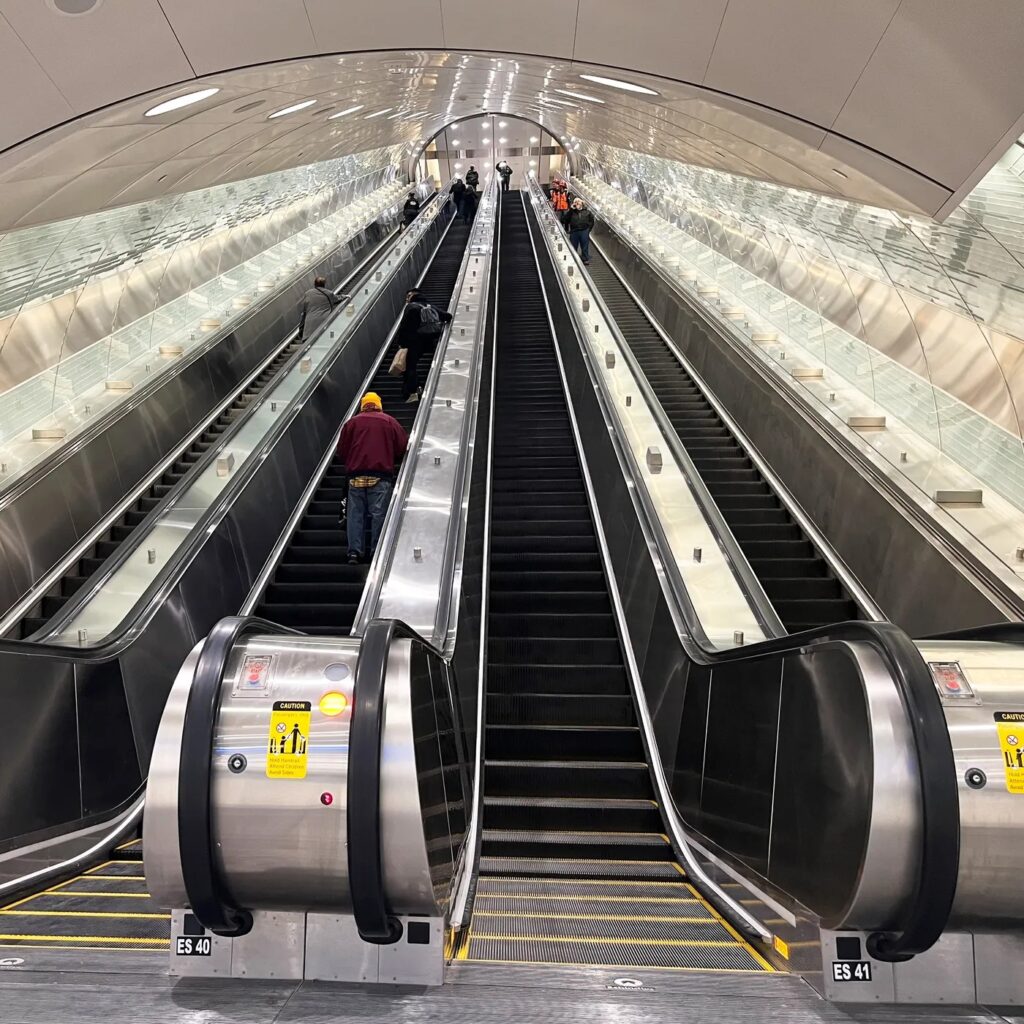
Long escalators descending to the platforms at Grand Central Madison

From Deep Platforms to Clear Directions

The depth of Grand Central Madison becomes tangible on the way down. Its 182-foot (55-metre) escalator ride is the longest in New York City, taking about one minute and 38 seconds. As you descend, the familiar spaces of the historic terminal give way to a new railway far below them.

Moving people through such a large underground station requires more than escalators. Entrances, concourses, passageways and platforms must form routes passengers can understand while making everyday connections. Grand Central Madison incorporates passive wayfinding, including directions set into elements of the built environment rather than relying only on signs overhead.

For a visitor, it is worth paying attention to that transition. Notice where you begin, how the route changes as you descend, and which visual cues help you find the platforms or return to street level. The design of the journey is part of the station’s engineering.

Art and Architecture Underground

Grand Central Madison was designed as more than a place to board a train. Its public spaces have a character distinct from the historic terminal above, while some architectural choices acknowledge Grand Central’s older design.

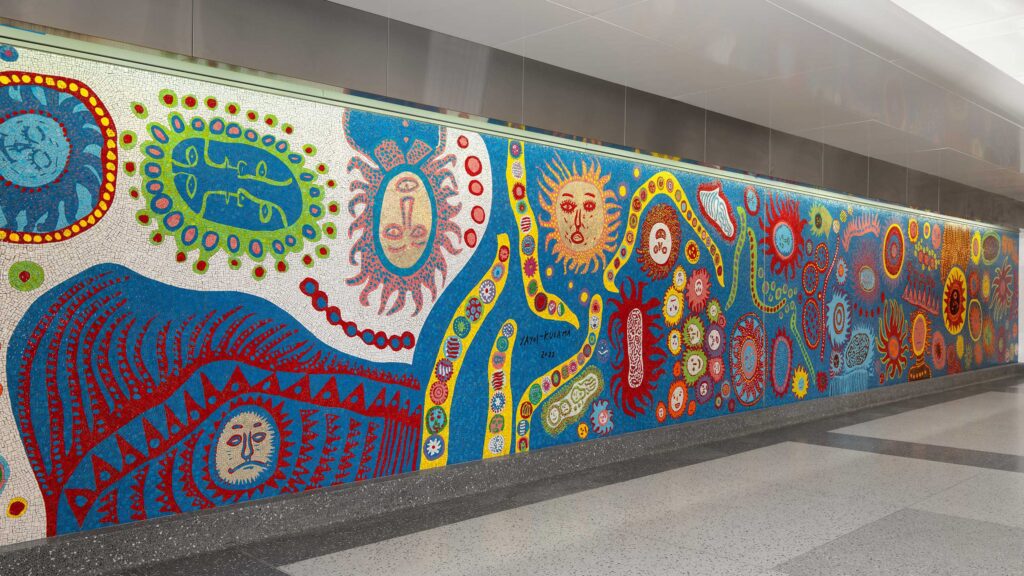
Art is part of the everyday route. On the Madison Concourse between 46th and 47th Streets, Yayoi Kusama’s large mosaic, A Message of Love, Directly from My Heart unto the Universe, brings vivid colour and her distinctive imagery into the station. Kiki Smith’s mosaics appear in other concourse and cavern spaces, drawing on forms from the natural world. The MTA also presents changing photography and digital artworks within Grand Central Madison’s cultural corridor. Together, these works make the passage through the station an encounter with public art, whether a traveller sets out to look for it or meets it on a routine journey.

That is a fitting result for such a complex project. Engineers created the spaces needed for trains and passengers; artists helped give those spaces an identity of their own.

Exploring Grand Central Madison

Grand Central Madison is an operating Long Island Rail Road terminal. Visitors can experience its public concourses, see the artworks and descend towards the platforms without joining a behind-the-scenes tour. Allow enough time for the journey between the historic Grand Central spaces and the deeper LIRR terminal; it is part of what makes the visit memorable.

For a guided introduction, the New York Transit Museum occasionally offers a Grand Central walking tour that traces the complex’s expansion to Grand Central Madison. It is a broader railway history walk, so check the current programme and its stated route before booking. The museum says the walk can be adapted for visitors who cannot use stairs when arrangements are made in advance.

Grand Central Madison also belongs within a wider story of structures that can be experienced from the inside. Our Engineering Landmarks collection explores other places where ambitious construction has become part of the visitor experience.

Our Verdict

Grand Central Madison is impressive for what you can see and for the engineering hidden beneath it. Its long escalators take you down into a vast new railway terminal built below one of Manhattan’s busiest districts. The journey also takes you between two visual worlds. The historic Grand Central Terminal has its classical grandeur; Madison welcomes you with contemporary mosaics and digital art that give the newer station a distinctly 21st-century character. Ride the escalators, seek out the artworks and give yourself time to explore. This is an engineering achievement you can experience simply by walking through it.

Colourful mosaic mural with faces and abstract shapes along a corridor at Grand Central Madison.

Related posts

Channel Tunnel illustration showing Eurostar and LeShuttle trains beneath the English Channel, with Folkestone and Coquelles marked above.

London–Paris via the Channel Tunnel

Travel beneath the English Channel and discover the engineering behind the Channel Tunnel. Explore its three-tunnel design, meet the construction story at Coquelles’ heritage centre, and visit Samphire Hoe’s reclaimed coastline. Then consider how this remarkable connection changed the London–Paris journey — and the choice between taking a train and flying.
Read More »

Grand Central Terminal: New York Icon

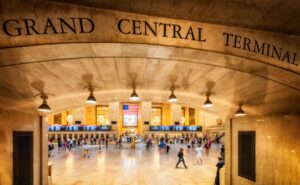
Grand Central Terminal combines a monumental public space with a working railway. Its electric tracks, two underground platform levels and hidden systems explain how the station keeps New York moving. Follow the engineering story, then look up at the Main Concourse ceiling and discover the details you can still see during a visit.

Read More »

The Hoover Dam

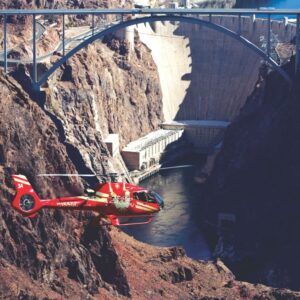
Discover Hoover Dam, one of America’s great engineering landmarks. Explore how engineers diverted the Colorado River, cooled millions of cubic yards of concrete and built a structure that still controls water and generates power today — while tours, exhibitions and viewpoints reveal the remarkable story behind its construction.

Read More »
Scroll to Top