Channel Tunnel: The Engineering Behind an Undersea Journey

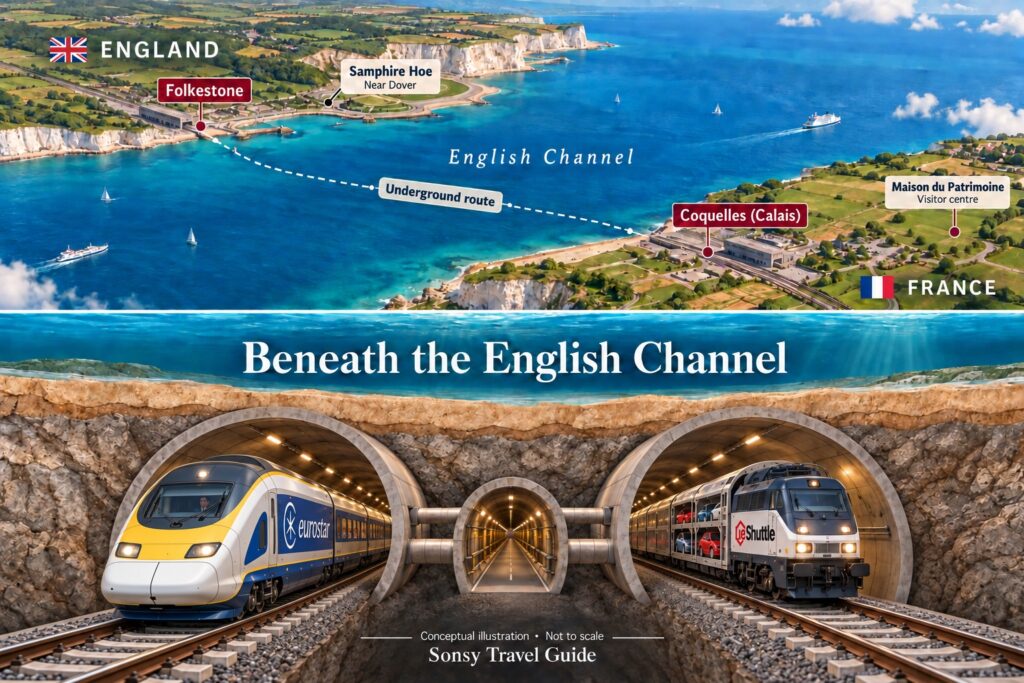
Channel Tunnel illustration showing Eurostar and LeShuttle trains beneath the English Channel, with Folkestone and Coquelles marked above.

Some engineering landmarks announce themselves from miles away. The Channel Tunnel keeps almost everything out of sight. Settle into a train seat, watch the daylight disappear, and the next stretch could seem like any other railway tunnel. Yet above you lies the English Channel, while your train travels through rock beneath its seabed.

Around 50.5 kilometres long, with approximately 38 kilometres beneath the sea, the Channel Tunnel has the world’s longest undersea tunnel section. For us, it belongs in our Engineering Landmarks collection because understanding how it was built changes the way we experience the journey. Its story brings together enormous machinery, underground problem-solving and the ambition to connect two countries more closely.


Building the Channel Tunnel from Opposite Shores

Imagine beginning an excavation in England while another team starts in France, with the expectation that your underground routes will eventually meet. Work began on the British side in 1987 and in France in 1988. Eleven tunnel boring machines were used across the project, following chalk strata beneath the seabed. The route changes direction and level to suit the geology rather than drawing a perfectly straight line between the two countries.

The smaller service tunnel advanced first, helping engineers understand the ground conditions before the larger railway tunnels followed. Conditions were wetter on the French side, adding to the challenge. Behind the cutting machinery, concrete rings and, in some sections, cast-iron segments formed the permanent lining. Every advance meant both removing material and securing the space left behind.

On 1 December 1990, the two halves of the service tunnel were joined. The railway tunnels followed in 1991, but a passage through the rock was still a long way from a working railway. Tracks, communications, ventilation and safety systems had to be installed before Queen Elizabeth II and President François Mitterrand officially inaugurated the link on 6 May 1994. The breakthrough made the headlines; the work that followed made everyday travel possible.

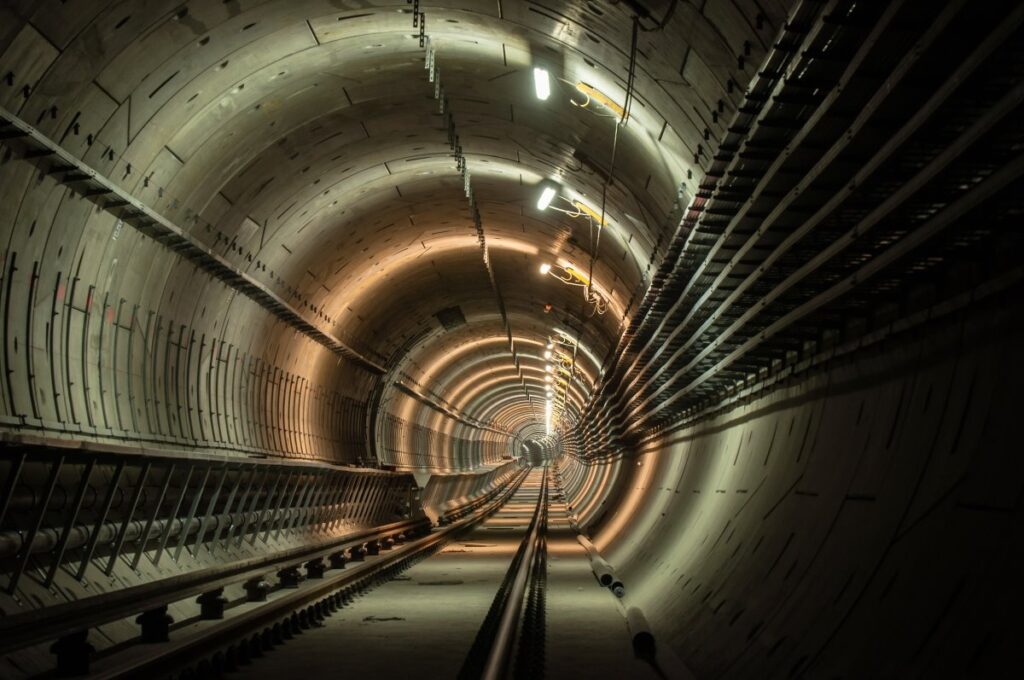
Railway tunnel interior with concrete lining, tracks, lighting and cables along the walls.

Three Tunnels Working as One System

Despite its name, the Channel Tunnel is a system of three parallel tunnels. Two carry trains, each containing one railway track — a pair of rails. A smaller service tunnel runs between them. Cross-passages every 375 metres connect the railway tunnels to that central corridor, providing maintenance access and an evacuation route when needed. Higher air pressure in the service tunnel helps keep smoke out during a fire.

Two large crossover caverns allow trains to switch between the railway tunnels, giving operators flexibility during maintenance. The infrastructure beneath the Channel also includes cooling, ventilation, drainage and fire-protection systems. Electricity can be supplied from either shore, and either rail control centre can take over operation of the system.

Water seeping through the surrounding ground is collected and pumped away. Keeping the crossing operational therefore involves much more than maintaining the rails: the tunnel’s structure, power supply and environmental systems all need continuing attention.

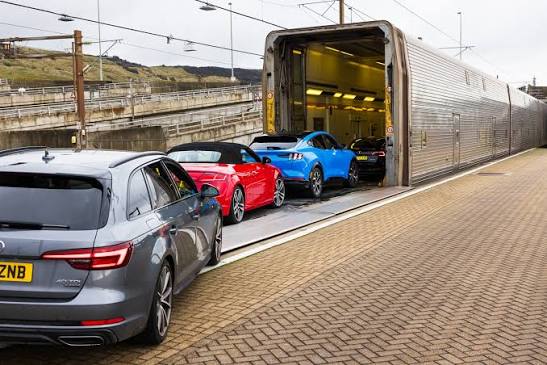
Cars boarding a LeShuttle vehicle train for the Channel Tunnel crossing.

Eurostar or LeShuttle: Choosing Your Crossing

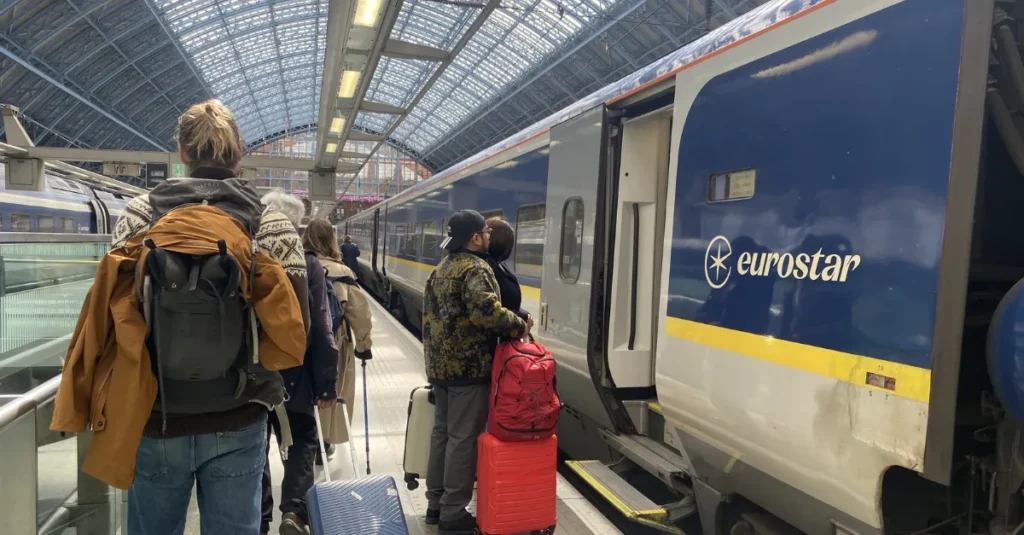
The names can be confusing when planning a first trip. Eurostar carries passengers between London St Pancras International and destinations including Paris and Brussels. LeShuttle carries vehicles and their occupants between Folkestone and Coquelles, near Calais. They use the same tunnel system but serve different journeys: one might suit a city break with a suitcase, the other a road trip with the car packed for several weeks.

With LeShuttle, you drive onto a railway shuttle that carries your vehicle through the tunnel. You cannot drive independently along the railway route. Its advertised crossing takes around 35 minutes under normal conditions. Eurostar’s city-to-city journey takes longer because the tunnel is only one section of its route.

Anyone hoping for an underwater panorama will have to adjust their expectations. Through a Eurostar window, the undersea section offers darkness, reflections and occasional glimpses of tunnel walls. There are no views of passing ships or fish. Looking at a diagram beforehand can make the experience more interesting, helping you picture your train’s position beneath the seabed.

A French Visitor Centre: Maison du Patrimoine

In Coquelles, near the French terminal, the Maison du Patrimoine puts people and pictures behind the engineering. Its exhibition, Un tunnel et des hommes — “A Tunnel and Its People” — brings together photographs, films and documents about the construction. The collection draws on the work of the Channel Tunnel Builders Association, preserving the experiences of those involved in the project.

The association reported that the exhibition reopened in an expanded space in 2026. Visitors can explore the Sangatte construction shaft through a virtual-reality headset, while volunteer interpreters help explain the story. It is a chance to imagine the huge building site, the machinery and the working lives behind a journey that now feels routine.

The centre is at 1062 Avenue Charles de Gaulle, beside Coquelles town hall. Published visiting days are Tuesday and Wednesday afternoons and the first Saturday afternoon of each month; confirm current opening hours before making a special trip. This is a heritage exhibition, and admission does not include access to the operating tunnel. Special behind-the-scenes events have taken place, but they should not be assumed to be regularly available.


Samphire Hoe: A Landscape Made from the Tunnel

On the English side, the construction story takes a different form at Samphire Hoe, below Shakespeare Cliff between Dover and Folkestone. Almost five million cubic metres of excavated material were used to reclaim land from the sea. Much of that land became a nature reserve, while another part accommodates the tunnel’s British cooling plant.

There is something particularly satisfying about this connection. You can travel through the space left by the excavation, then walk on a landscape created from what was taken out. Instead of disappearing into a distant disposal site, the material became the foundation for a new stretch of coast.

The cliffs and open sea make Samphire Hoe an appealing addition to a Kent itinerary, especially for travellers who enjoy combining an engineering story with time outdoors. It is a separate coastal visit, so plan it as a stop before or after your crossing.


Accessibility and Planning a Comfortable Visit

Eurostar has dedicated wheelchair spaces and boarding assistance. Its current guidance requires wheelchair users to book a suitable space and request assistance at least 24 hours before travel. Check the Eurostar accessibility information for your departure station and any connecting services. For travellers using an adapted vehicle, LeShuttle’s restricted-mobility guidance explains the arrangements to make before departure.

For the visits on either shore, check the practical details that matter to you. Samphire Hoe has a recommended accessible circuit with surfaced paths, but the site also includes gradients and steeper sections; its visitor information describes the route. Contact the Maison du Patrimoine before visiting to confirm entrance access, facilities and the suitability of the VR experience for your needs.

Even without a wheelchair, walking distances, luggage and time spent standing can influence how comfortable an outing feels. Consider these alongside the attraction itself when deciding how much to fit into the day.

London to Paris: Train or Flight?

Six or seven hours, a ferry crossing and changes along the way: travelling from London to Paris by rail and sea once took a substantial part of the day. Today, a direct Eurostar journey from London to Paris can take as little as two hours and sixteen minutes. Compared with those earlier rail-and-ferry journeys, that is roughly four hours saved, sometimes more.

The improvement did not happen all at once. The tunnel made a direct railway connection possible, while the high-speed lines on either side helped make it faster. Britain’s HS1 opened in stages in 2003 and 2007, cutting roughly another twenty minutes from the journey each time. Today’s timetable reflects both the undersea engineering and the railway built to connect with it.

The scale of use shows how thoroughly the crossing has become part of everyday travel. In 2025, Eurostar recorded around 11.8 million passenger journeys through the tunnel, while LeShuttle carried another 8.3 million passengers with their vehicles. Together, that is approximately twenty million passenger journeys across the two services. These figures cover more than the London–Paris route, count journeys rather than unique individuals, and exclude drivers travelling on freight shuttles.

For travellers, the comparison with flying is where those engineering achievements become especially relevant. A flight may look quicker when we compare only the time in the air with the train timetable. Add airport transfers, check-in, security and boarding, and the calculation changes. Eurostar also requires advance arrival for security and border checks, so follow the operator’s current instructions when planning your departure.

The best choice depends on where your journey begins and ends. An onward flight or a stay near an airport may favour flying; a trip between central London and central Paris often makes the train particularly appealing. As we explore in Train Journeys vs. Flying, the useful comparison is the whole journey — including luggage, transfers and the energy left when you arrive. The Channel Tunnel gives travellers a choice that previous generations simply did not have: stepping onto a train in one capital and stepping off in the other, with the sea crossed along the way.

Related posts

Grand Central Madison concourse with curved arches, track signs and a mosaic artwork.

Grand Central Madison New York

Explore Grand Central Madison beneath Manhattan, from its deep platforms and long escalators to the engineering that made the station possible. Discover the contemporary mosaics and digital art that make the journey through New York’s newest rail terminal an experience in itself.

Read More »

Grand Central Terminal: New York Icon

Grand Central Terminal combines a monumental public space with a working railway. Its electric tracks, two underground platform levels and hidden systems explain how the station keeps New York moving. Follow the engineering story, then look up at the Main Concourse ceiling and discover the details you can still see during a visit.

Read More »

The Hoover Dam

Discover Hoover Dam, one of America’s great engineering landmarks. Explore how engineers diverted the Colorado River, cooled millions of cubic yards of concrete and built a structure that still controls water and generates power today — while tours, exhibitions and viewpoints reveal the remarkable story behind its construction.

Read More »
Scroll to Top