
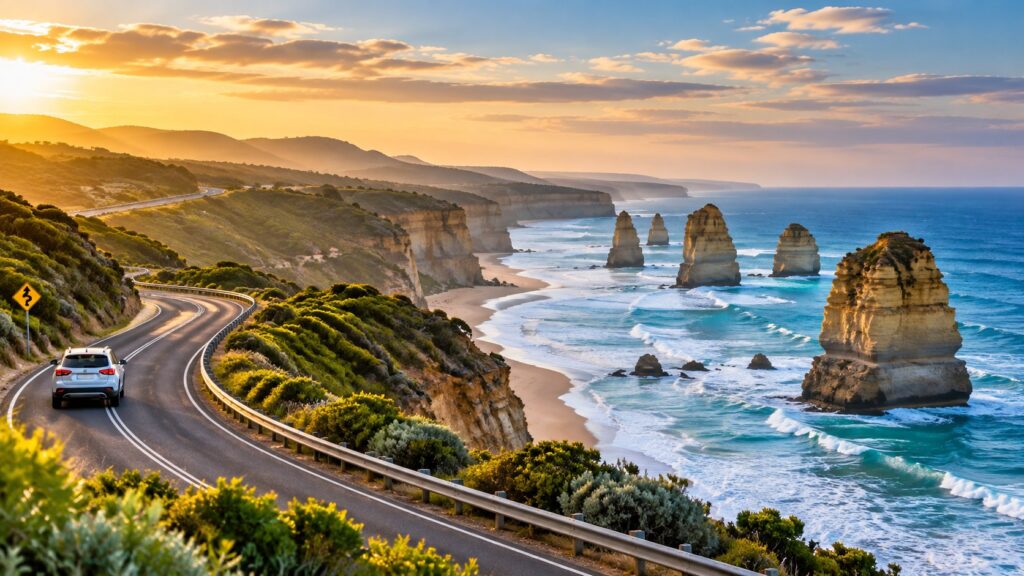

Scenic coastal drive along the Great Ocean Road in Victoria, Australia

Great Ocean Road: Australia’s Most Iconic Coastal Drive

The Great Ocean Road follows the southern coast of Victoria for around 240 kilometres, linking surf towns, beaches, forests and dramatic limestone cliffs along one of Australia’s best-known driving routes.

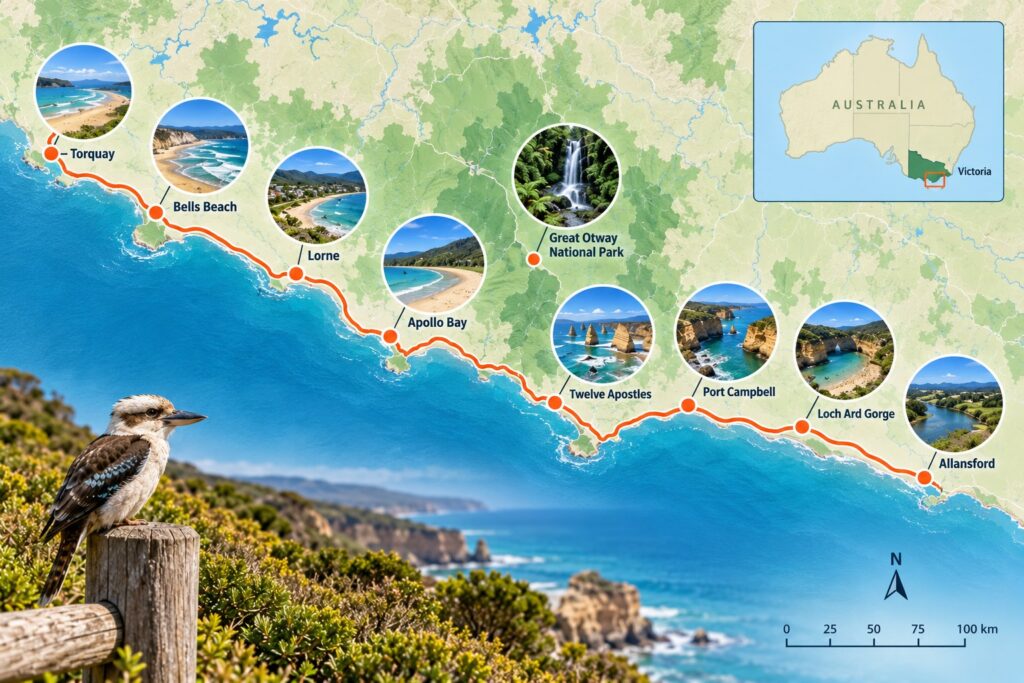
Beginning near Torquay and continuing west towards Allansford, the road is often associated with the Twelve Apostles. But the famous rock formations are only one part of the journey. The route passes through very different landscapes and communities, making the drive itself far more interesting than simply travelling from one major attraction to another.

For travelers who enjoy discovering a country through its iconic routes, the Great Ocean Road offers a particularly good combination of scenery, history and the freedom of a self-drive journey.

A Road Built as a War Memorial

There is more behind the Great Ocean Road than spectacular scenery. Construction began in 1919, shortly after the end of the First World War. More than 3,000 returned servicemen were involved in building the road, working through difficult terrain with relatively basic equipment. The project had several purposes. It provided employment for returning servicemen, improved access to isolated coastal communities and created a lasting memorial to Australians who had served during the war. Construction continued for more than a decade, with the completed route officially opened in 1932.

Today, the Great Ocean Road and Scenic Environs is included on Australia’s National Heritage List. Its heritage significance reflects not only the road’s association with returned servicemen, but also its engineering, coastal landscape and role in the development of tourism in Victoria.

Great Ocean Road route map showing major stops from Torquay to Allansford in Victoria

Great Ocean Road Highlights

The Great Ocean Road contains enough beaches, viewpoints, towns, and walking trails to fill several days. These are some of the places that help define the journey.

Bells Beach
Close to Torquay, Bells Beach is closely connected with Australia’s surfing culture. Even for visitors who have no intention of entering the water, it provides an appropriate introduction to Victoria’s Surf Coast.

Lorne
A popular seaside town surrounded by forested hills, Lorne makes a natural stopping point before the road continues along one of its most scenic coastal sections.

Apollo Bay
Set between the ocean and the Otway Ranges, Apollo Bay is well positioned for an overnight stop. It also marks the transition between the open coastal road and the forest landscapes farther west.

Great Otway National Park
The Otways add an entirely different environment to the journey. Rainforest, waterfalls and tall trees provide opportunities to leave the car behind for short walks before continuing towards Port Campbell.

The Twelve Apostles
These limestone stacks rising from the Southern Ocean have become the best-known image of the Great Ocean Road. Despite the name, there were not originally twelve stacks, and continuing erosion means the coastline is still changing.

Loch Ard Gorge
A short distance from the Twelve Apostles, Loch Ard Gorge combines dramatic cliffs and a sheltered inlet with the story of the Loch Ard, a sailing ship wrecked nearby in 1878. Only two of the 54 people on board survived.

There are many other possible stops, but trying to include every viewpoint can turn the journey into a sequence of car parks. Choosing fewer places and spending longer at them often makes for a better road trip.

How Many Days Do You Need?

The Great Ocean Road is frequently offered as a day trip from Melbourne, and seeing some of its major sights in a single long day is possible.

But there is a difference between seeing the Great Ocean Road and travelling it.

With one day, you will need to be selective. Much of the time will be spent driving, particularly if you also need to return to Melbourne.

Two days gives the journey much more breathing room. An overnight stop around Apollo Bay or elsewhere along the route makes it possible to combine coastal viewpoints with a walk or two without constantly checking the time.

With three days, there is considerably more flexibility for the Otways, smaller coastal towns and stops farther west. Visit Victoria website also presents the route as a three-day self-drive itinerary, which gives a useful indication of how much there is to see along the way. For most independent travelers, we think two or three days is the better balance.

Best Time to Drive 

The route can be driven throughout the year, but the experience changes noticeably with the seasons.

Summer (December–February) offers longer daylight hours and generally warmer conditions. It is also a popular period for Victoria’s coastal towns, so accommodation and major attractions can be busier.

Autumn (March–May) brings cooler temperatures and can be a comfortable period for driving and walking.

Winter (June–August) creates a very different atmosphere. The Southern Ocean can look particularly dramatic in rough weather, while parts of Victoria’s south-west coast also offer seasonal opportunities for whale watching. Days are shorter, however, and conditions can be wet and changeable.

Spring (September–November) brings longer days and greener landscapes as the region moves towards summer.

Whichever season you choose, it is worth keeping some flexibility in the itinerary. Weather on Victoria’s southern coast can change quickly.

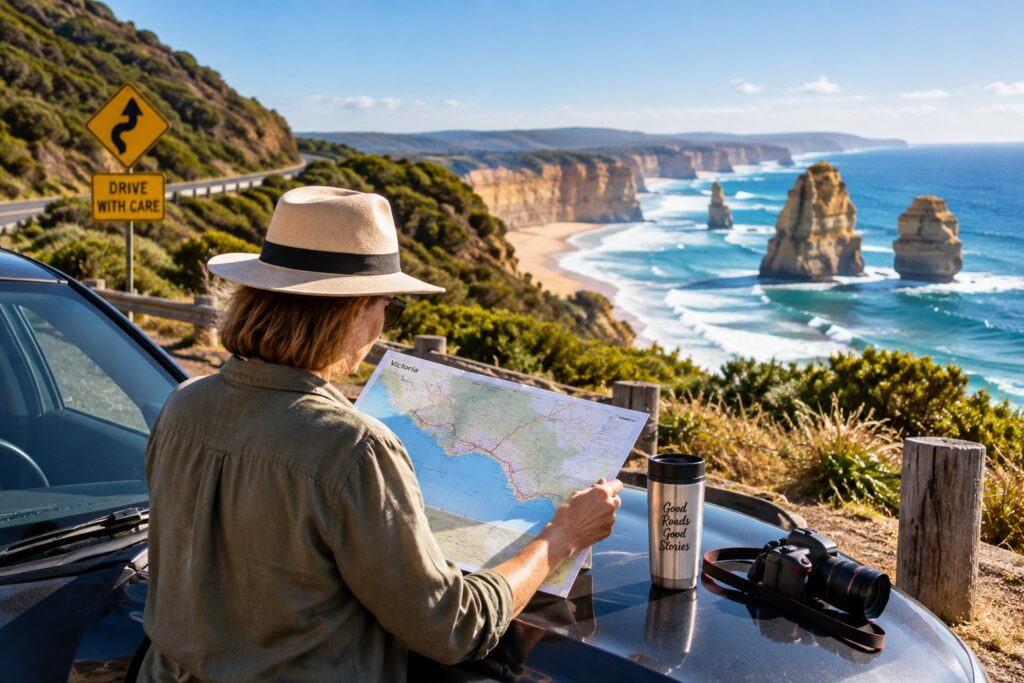
Traveler checking a map beside a car during a coastal road trip in Victoria, Australia

Practical Tips for the Drive

Australia drives on the left-hand side of the road, something international visitors should keep firmly in mind when leaving car parks, viewpoints and junctions.

The Great Ocean Road also contains winding sections where distances on a map can be deceptive. Do not calculate the day solely from the estimated driving time between towns. Scenic stops, walks and slower sections of road all add time.

Travelling from Torquay towards Lorne and Apollo Bay is the traditional direction and places the ocean on the left side of the vehicle along much of the famous coastal section. The reverse journey is perfectly possible, however, and may fit a wider Australian itinerary better.

Drivers should use designated viewpoints rather than trying to admire the scenery while moving. On a road like this, regular stops are as useful for the driver as they are for everyone else in the car.

It is also worth checking current road and weather conditions before departure. Bushfires, storms, landslides or maintenance can occasionally affect roads and walking areas in the region.

If you are renting a car, check what your rental agreement allows before planning detours onto unsealed roads.

Is the Great Ocean Road Worth It?

Yes – especially if you enjoy road trips where the journey matters as much as the destination. If that is your kind of travel, America’s Route 66 offers a very different take on the same idea.

The Twelve Apostles provide the instantly recognisable photograph, but they should not become the only purpose of the journey. Small coastal towns, stretches of open road, beaches and the forests of the Otways create a much more varied experience than the familiar images suggest.

The Great Ocean Road works best when there is enough time for plans to remain slightly flexible. Stop when something looks interesting, take a short walk, and accept that you probably will not see everything.

That is not a failure of planning.

On a journey like this, the places you did not plan to stop can sometimes become the ones you remember.

Related posts

Darjeeling Himalayan Railway

The Darjeeling Himalayan Railway climbs through West Bengal on a historic narrow-gauge line. Learn what makes its engineering distinctive, where Batasia Loop and Ghoom fit into the route, and how to choose a train journey.


Read More »

Swiss Mountain Tracks

The Bernina Express crosses the Alps through high mountain scenery and remarkable railway engineering. This guide follows the changing landscape from glaciers to valleys and helps you decide how to experience the route.

Read More »

The Ultimate American Road Trip

Route 66 is America’s legendary road trip, stretching from Chicago to California through eight states. Discover historic towns, desert landscapes, classic roadside landmarks and surviving sections of the Mother Road, plus practical tips for planning the journey and experiencing the Route 66 centennial in 2026.

Read More »
Grand Canyon Railway steam locomotive in Arizona

Grand Canyon Railway

Grand Canyon Railway offers a historic train journey from Williams, Arizona, to the South Rim. Travel through changing Northern Arizona landscapes, discover the railway’s Wild West entertainment and vintage carriages, and arrive at the historic Grand Canyon Depot just a short walk from the canyon rim.

Read More »
Historic Orient Express dining car with original wooden interior

Orient Express

The Orient Express has defined luxury rail travel for more than a century. Discover its fascinating history, how the Venice Simplon-Orient-Express recreates the experience today, the classic routes from Paris to Venice and Istanbul, what life aboard is really like, current costs, and whether this legendary train journey is worth it.

Read More »
Scroll to Top