The Wadden Sea: Where the North Sea Disappears

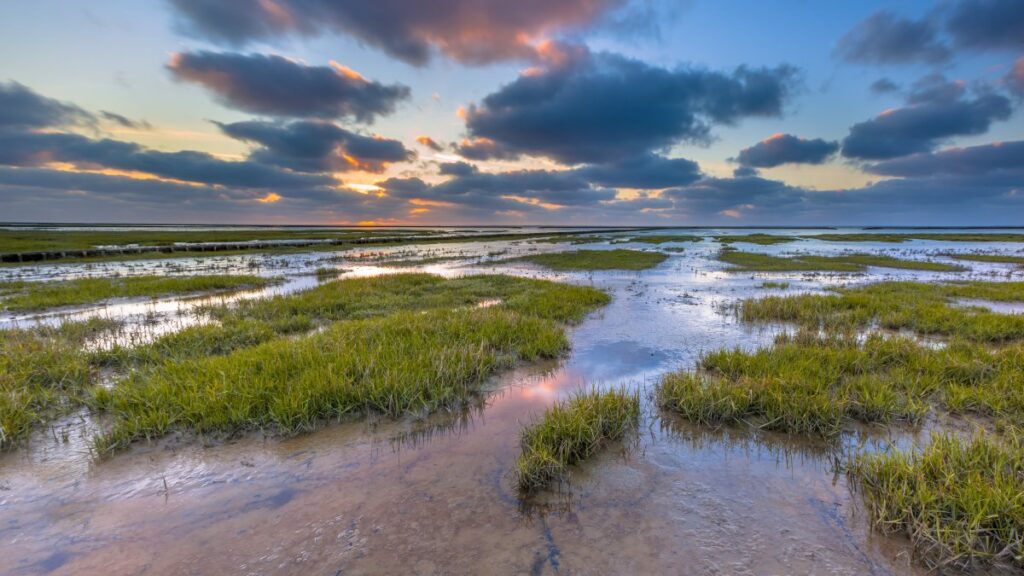
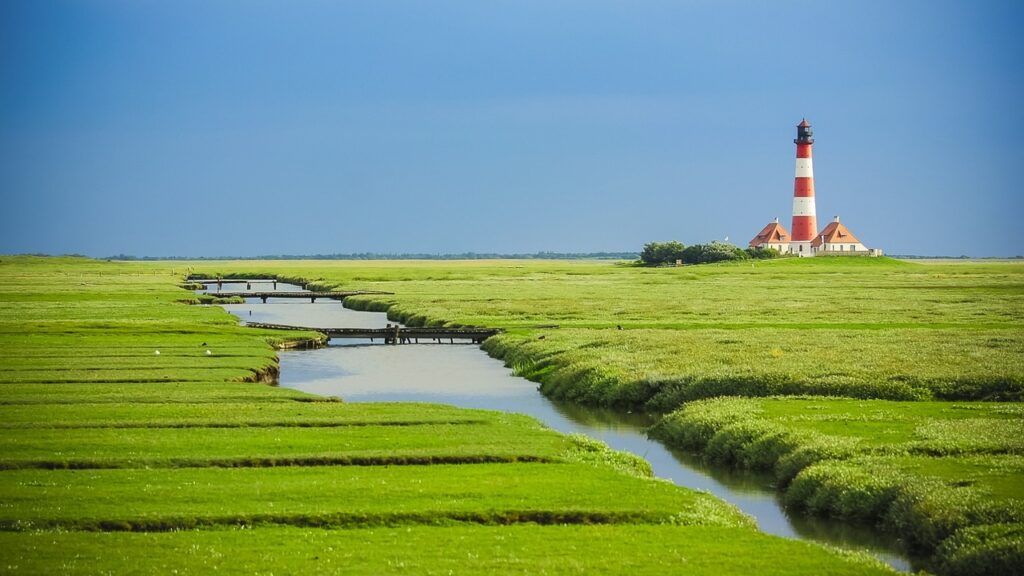
Wadden Sea salt marshes with lighthouse and tidal channel

At first glance, the Wadden Sea can look almost empty. The horizon stretches across enormous flats of wet sand and mud, broken by tidal channels, distant islands and flocks of birds. Then the tide turns, the water begins to return, and the landscape starts changing before your eyes. Stretching along the North Sea coasts of the Netherlands, Germany and Denmark, the Wadden Sea is the world’s largest unbroken system of intertidal sand and mudflats. Twice each day, vast areas are alternately exposed and covered by the sea, creating one of Europe’s most dynamic natural landscapes. This constant movement supports an immensely productive ecosystem that provides habitat for seals, fish, shellfish and millions of migratory birds.

A Landscape Created by the Tides

The Wadden Sea exists in the shifting zone between land and open sea.

Barrier islands and sandbanks shelter the shallow waters behind them, while tides repeatedly move seawater through a network of channels and gullies. At low tide, large expanses of seabed emerge. Several hours later, much of that landscape disappears beneath the North Sea again. The wider ecosystem includes tidal channels, sandbanks, salt marshes, dunes, beaches, seagrass meadows and mussel beds, each providing different conditions for plants and animals.

Sediment is constantly being deposited, removed and rearranged. Channels migrate, sandbanks change shape and salt marshes develop at the boundary between land and sea. The landscape visitors see today is therefore not a finished geological formation but a coastal system that continues to evolve.

Tidal salt marshes and mudflats in the Wadden Sea

Why the Wadden Sea Is World Heritage

The scale and ecological importance of this landscape led to its recognition as a UNESCO World Heritage Site, but today’s international property was created in stages.

The Dutch Wadden Sea Conservation Area and the German Wadden Sea National Parks of Lower Saxony and Schleswig-Holstein were inscribed in 2009. The Hamburg Wadden Sea National Park was incorporated through a boundary modification in 2011, and in 2014 the World Heritage property was significantly extended to include the Danish Wadden Sea.

Today, the protected World Heritage property covers more than 1.1 million hectares across the three countries.

UNESCO recognises the Wadden Sea under three natural World Heritage criteria. Its geological importance comes from the continuing development of an exceptionally large sandy barrier coast. Its ecological value lies in one of the world’s remaining large-scale intertidal ecosystems where natural processes can still operate across an enormous area. Its biodiversity, particularly its importance for migratory birds, gives the landscape global significance.

The Wadden Sea is therefore protected not because of a single spectacular feature, but because an entire natural system continues to function on a scale rarely found elsewhere. There is no cathedral, palace or archaeological ruin at its centre. The heritage here is the continuing interaction of water, wind, sediment, plants and wildlife.

For other places where landscapes and human history have been recognised for their exceptional global significance, explore our World Heritage collection.

Millions of Birds and Life Beneath the Mud

Few statistics reveal the Wadden Sea’s importance better than its bird population.

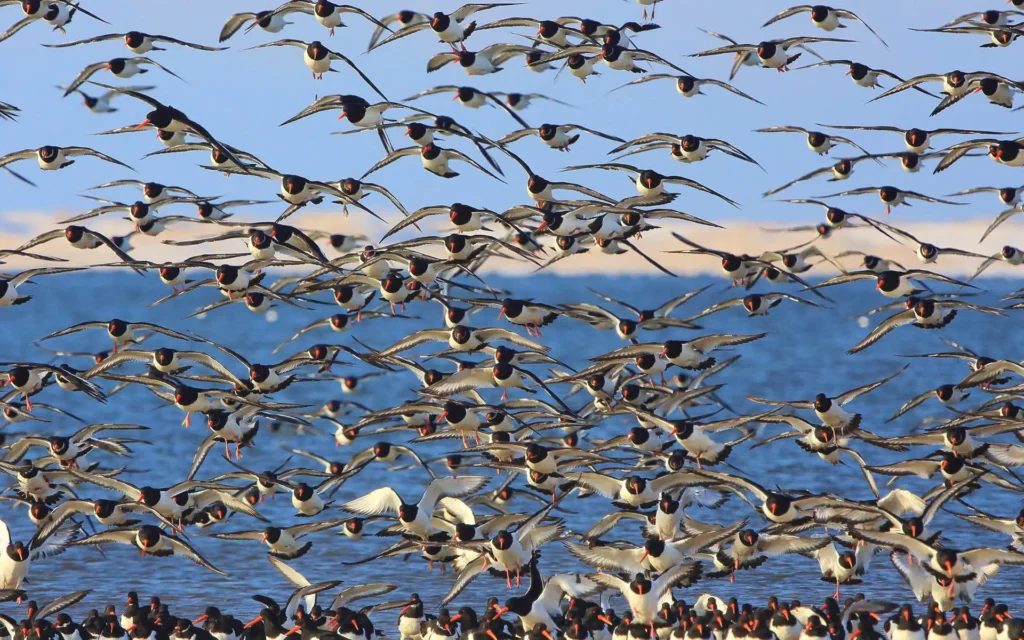
An average of 10–12 million migratory birds pass through the Wadden Sea each year, and as many as 6.1 million can be present at the same time.

The mudflats support enormous quantities of worms, shellfish and other small animals. When the tide retreats, birds gain access to this natural feeding ground, allowing them to replenish the energy needed for journeys that can extend across continents. The Wadden Sea is a crucial stop along the East Atlantic Flyway, the migration route linking breeding grounds in northern regions with wintering areas that can extend into Africa. Birds use the area for feeding, resting, moulting or spending the winter.

Protecting the Wadden Sea therefore has consequences far beyond the North Sea coast. Migratory species depend on a chain of suitable habitats along their routes, and the loss of one major stopover can affect populations thousands of kilometres away. Birds are only the most visible part of the ecosystem.

The salt marshes support thousands of species of plants and animals, while harbour seals, grey seals and harbour porpoises are among the Wadden Sea’s best-known marine mammals. Visitors may see seals resting on exposed sandbanks, particularly on boat excursions, while much of the food web that supports the region’s wildlife remains hidden within the tidal flats.

Flock of oystercatchers in the Wadden Sea

Four Ways to Experience the Wadden Sea

Because the Wadden Sea stretches across hundreds of kilometres of coastline, there is no single gateway. Different places reveal very different versions of the same ecosystem.


Texel – The Dutch Island Experience

At the western end of the Wadden Islands, Texel provides an accessible introduction to the Dutch side of the region. Beaches, dunes, salt marshes and bird habitats make the island particularly rewarding for cycling and nature watching. The Ecomare nature centre combines information about the Wadden Sea and North Sea with wildlife rehabilitation, making it a useful introduction to the ecology of the islands. Texel is reached by ferry from Den Helder, and the short crossing already begins to reveal the relationship between mainland, island and tidal sea.


Sankt Peter-Ording – The Wide German Coast

On Germany’s North Sea coast, Sankt Peter-Ording presents a very different landscape. Its enormous beach, dunes, salt marshes and distinctive buildings raised on stilts create one of the most recognisable coastal scenes in Schleswig-Holstein. At low tide, the scale of the open landscape becomes particularly apparent. Sankt Peter-Ording is also a useful base for discovering the Schleswig-Holstein Wadden Sea National Park, one of the protected areas that form the German part of the World Heritage property.

Travellers continuing through the country can find more ideas in our Germany travel guide.


The Halligen – Living with the Sea

Perhaps nowhere illustrates the relationship between people and the Wadden Sea more dramatically than the Halligen. These small, low-lying islands along the North Frisian coast differ from conventional islands because many lack continuous protective sea dikes. During exceptionally high tides and storm surges, seawater can cover large parts of the land in an event known locally as Landunter.

For centuries, inhabitants have adapted by building homes and other structures on artificial dwelling mounds known as Warften. When the surrounding land floods, these raised settlements can remain above the water.

The Halligen therefore offer more than beautiful scenery. They demonstrate a long history of human adaptation to a landscape where the boundary between land and sea has never been fixed. That centuries-old relationship also entered North German cultural memory: Detlev von Liliencron’s 19th-century ballad Trutz, Blanke Hans evokes the legendary destruction of Rungholt by a North Sea storm tide, turning the power of the sea into part of the region’s literary identity.


Rømø – Denmark’s Wadden Sea

Across the border in Denmark, the island of Rømø is known for its extraordinary expanse of sandy beach and a landscape shaped by wind and tides. A causeway connects the island to the mainland, making it one of the easiest Danish Wadden Sea islands to reach without a ferry. Its broad western beaches contrast with the more sheltered tidal landscapes facing the Wadden Sea.

Rømø can serve as a base for exploring the Danish section of Wadden Sea National Park. If the island is part of a longer trip, our Denmark travel guide explores more of the country’s coastal landscapes, cities and cultural traditions.

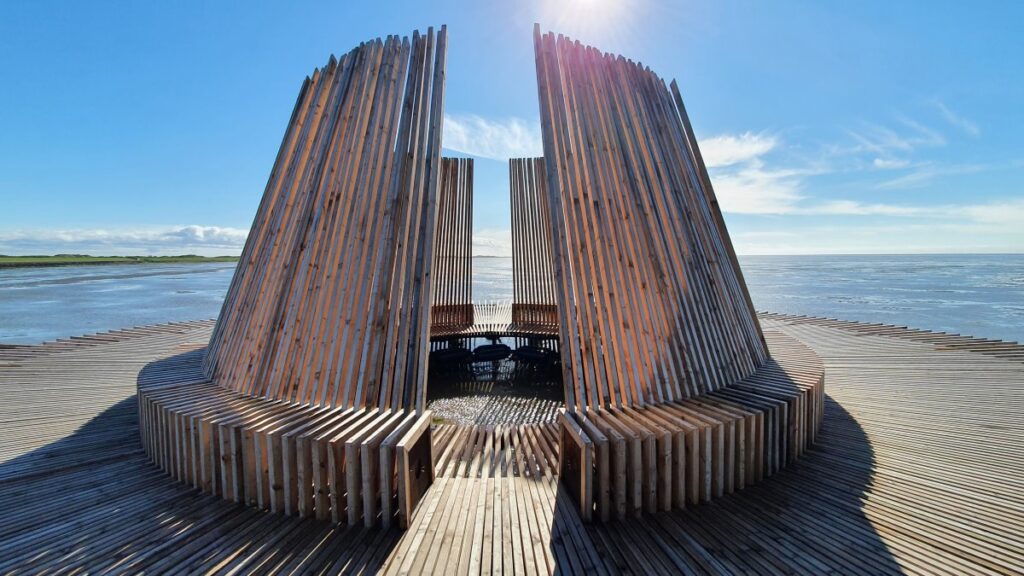
Wooden art installation overlooking the Wadden Sea

The Wadden Sea in Contemporary Culture

The changing landscape of the Wadden Sea continues to inspire artists and filmmakers. On the Dutch coast, Sense of Place uses visual art and design to connect people with the landscape and cultural history of the Wadden region. One of the projects associated with this approach is De Streken on Terschelling, a tidal artwork by Marc van Vliet developed through the Oerol Festival. Its relationship with tide, wind and landscape makes the environment part of the work rather than simply its backdrop. The connection between contemporary art and the Wadden landscape extends into Denmark. In 2026, Wadden Tide: Bringing In The Tide brings site-specific sculptures, installations and performances to locations including Blåvand Beach, Skallingen and Ho. The exhibition explores how people coexist with nature and the forces that shape the tidal landscape.

The Wadden Sea has also reached the screen. Pieter-Rim de Kroon’s documentary Silence of the Tides follows the rhythms and seasons of the Wadden Sea across the Netherlands, Germany and Denmark, focusing on the fragile relationship between people and nature.

Together, these contemporary works show that the Wadden Sea is more than a protected ecosystem. Its constant transformation continues to shape the way artists interpret landscape, time and the human relationship with nature.

Walking on the Seabed: Wattwandern

One of the most distinctive ways to experience the Wadden Sea is also the activity that demands the most respect.

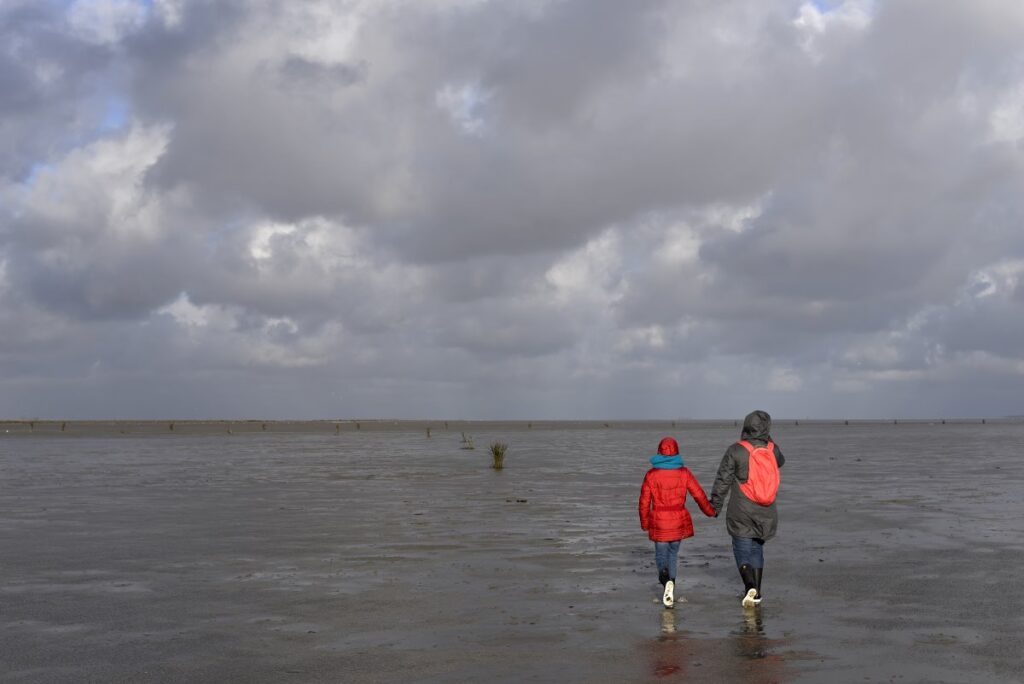
At low tide, parts of the seabed become accessible on foot, making Wattwandern – mudflat hiking – a long-established tradition along the German and Dutch coasts. Walking out onto the exposed seabed changes your sense of the landscape completely. The coast can become distant, tidal channels cut through the flats, and what looked like an empty stretch of mud begins to reveal shells, tracks and feeding birds. Some guided routes remain relatively close to shore, while others cross much greater distances. A few traditional routes even connect the mainland with islands.

But the fact that people can walk across the seabed does not make it an ordinary hiking environment. The tide returns, channels can fill before surrounding flats disappear beneath the water, fog can obscure landmarks, and areas that appear firm may contain unexpectedly deep or soft mud.

For first-time visitors, a guided mudflat walk with an experienced local guide is the sensible choice. Guides understand the tide, permitted routes, weather conditions and sensitive wildlife areas, while also explaining the natural processes that are easy to miss when walking alone. Official German National Park guidance also recommends tidal-flat hiking with experienced and qualified guides for both visitor safety and wildlife protection.

Mudflat hikers walking across the Wadden Sea at low tide

Planning Your Wadden Sea Visit

Exploring the Wadden Sea requires a different approach from visiting a single national park or monument. The World Heritage property stretches across a vast coastline, so choosing one region as a base is usually more rewarding than attempting to cover all three countries in one trip.

Rail connections reach many of the mainland gateways. Den Helder provides access to Texel, while German rail routes connect with several North Sea ports and coastal towns. In Denmark, road and rail connections lead towards the Wadden Sea coast, with Rømø connected to the mainland by causeway.

Ferries are part of everyday life across much of the region, linking the mainland with inhabited islands. Timetables can vary with route and season, so island connections are worth checking in advance.

The tide timetable is just as important as the transport timetable. A beach, tidal flat or wildlife-viewing area can look completely different at high and low tide, and some activities are only possible during particular tidal conditions.

Spring and autumn are especially important periods for bird migration. Summer brings longer days and generally makes cycling, island visits and coastal walks easier to combine, although popular resorts can be busy.

Weather deserves respect in every season. The exposed coast can be windy and considerably cooler than inland areas, even on apparently mild days. Layers, windproof clothing and footwear suited to wet conditions are particularly useful.

Visitor centres throughout the region can provide information about local habitats, current conditions, guided excursions and areas restricted to protect wildlife.

The Wadden Sea is not a place defined by a single viewpoint or landmark. Its character lies in the natural processes that continue around the clock and in the extraordinary concentration of wildlife that depends on them.

Here, World Heritage is not something frozen in the past. It is a living landscape, recreated with every tide.

Related posts

From Fairytale Castles to Modern Marvels

Explore Germany through historic cities, fairytale castles, river valleys and contemporary culture. From Berlin’s complex history to Bavaria’s traditions and the country’s engineering heritage, this guide combines distinctive regional cultural highlights with practical advice on transport, seasons, food and accessibility, helping you plan a varied journey at your own pace.

Read More »
Bayer Leverkusen fan inside the BayArena stadium

BayArena Stadium Tour

A behind-the-scenes tour takes you inside Bayer Leverkusen’s BayArena. Visit areas such as the players’ tunnel, pitchside, press conference room and VIP sections while discovering the character of one of Germany’s most compact modern football grounds. You’ll also find tips for planning your visit well in advance.

Read More »
Cologne World Heritage skyline with Cologne Cathedral and the Rhine

Cologne’s World Heritage

Cologne Cathedral is only one part of the region’s World Heritage story. Discover how the Roman frontier and the Rococo palaces of Brühl add different chapters, with practical guidance for visiting them.

Read More »

Denmark: Land of Fairy Tales, Hygge, and Coastal Charm

Explore Denmark through Copenhagen’s waterfront, Odense’s literary heritage and Aarhus’s contemporary art. Beyond the cities, discover sandy coastlines, island towns and tidal landscapes. This Denmark travel guide introduces local food and hygge, alongside practical advice on transport, accessibility, safety and choosing destinations that fit your interests and preferred travel pace.

Read More »
Nürburgring Nordschleife winding through the forested Eifel landscape in Germany

Nürburgring Experience

The Nürburgring Backstage Tour reveals another side of this historic circuit. See selected areas, learn about the Nordschleife and Green Hell, and find practical information on tickets, tour duration, accessibility and other visitor experiences, including how to plan your time there.

Read More »
Volkswagen Factory Tour in Wolfsburg, Germany

The City of Cars

Wolfsburg offers several ways to encounter Volkswagen’s history and production. Compare Autostadt’s exhibitions and visitor spaces with the separate factory tour to decide which experience belongs in your itinerary.

Read More »
Scroll to Top