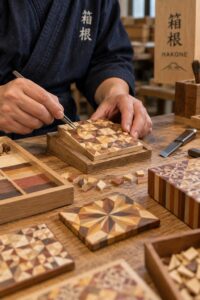
Japanese Woodworking
Japanese woodworking traditions range from interlocking kigumi joints to decorative techniques. This guide compares workshop experiences and shows how working by hand at the bench reveals the logic behind each craft.

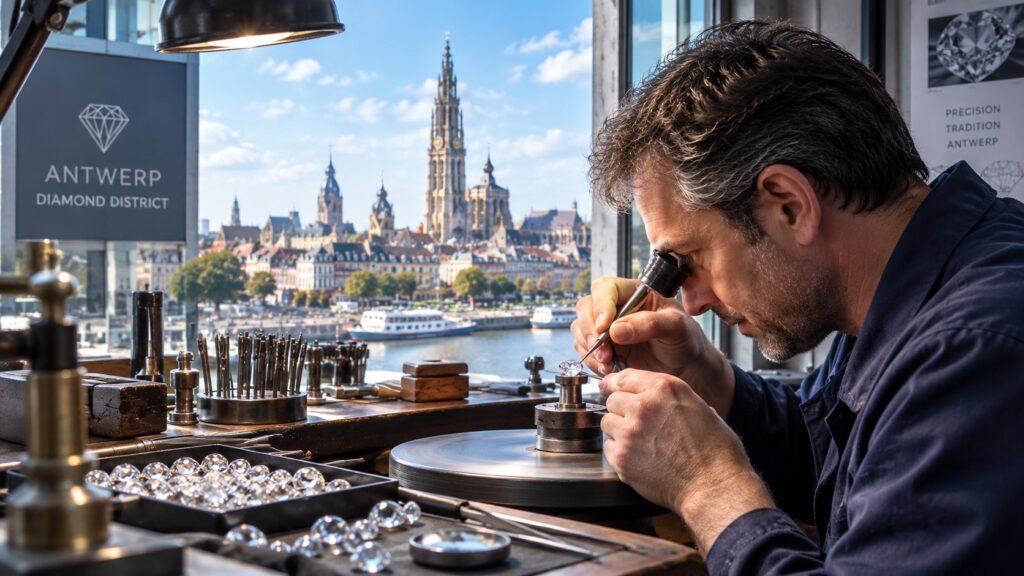
For more than five centuries, Antwerp has been closely connected with the diamond trade. But this is not simply a historical story. Behind the streets near Antwerp Central Station is a highly specialised industry that continues to sort, value, trade and, in some cases, polish some of the world’s most valuable stones.
For travelers interested in craftsmanship, manufacturing and the story behind everyday luxury products, Antwerp offers something unusual. There is no single “Antwerp Diamond Experience” or conventional factory tour. Instead, the experience is spread across the city’s Diamond District, the DIVA museum and opportunities to learn about the skills that transform rough stones into finished gems.
That distinction is important. You will not normally walk freely through commercial cutting rooms or trading floors. Security and confidentiality are fundamental to the industry. What Antwerp offers instead is a way to understand an industry that usually operates largely out of public view.
Antwerp’s diamond history stretches back more than 580 years. Today, more than 1,300 diamond companies remain connected to the city, while the tightly secured Diamond Square Mile near Central Station contains trading offices and four of the world’s diamond bourses.
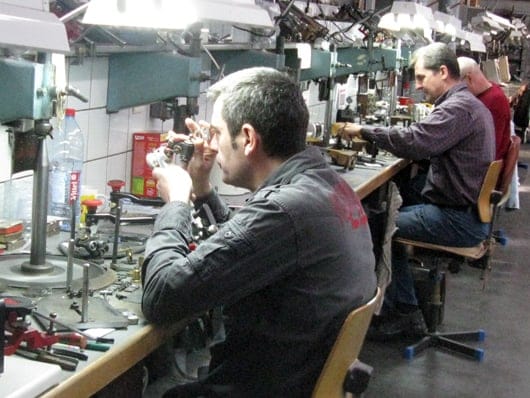
The industry has changed considerably. Much of the world’s diamond polishing now takes place in India, while Antwerp has retained particular expertise in sorting and valuing rough diamonds and polishing high-value stones.
That actually makes the city more interesting from a manufacturing perspective. The diamond story here is not simply about jewellery shops. It involves an international supply chain connecting mines, traders, specialist graders, polishers, certification and eventually the consumer.
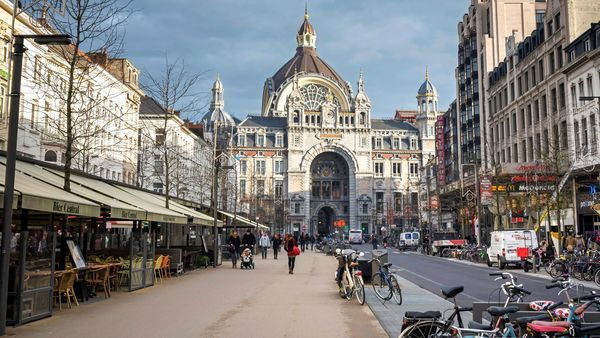
The Diamond District begins almost immediately beside Antwerp Central Station, making it one of the easiest industrial districts to encounter during a city visit.
Do not expect a picturesque historic quarter. Much of the area looks surprisingly functional: offices, security systems, jewellery businesses and heavily controlled entrances occupy a compact network of streets.
That contrast is part of what makes it interesting.
Behind relatively ordinary façades, diamonds worth substantial sums are sorted, valued and traded. Antwerp also remains particularly important for so-called “run of mine” productions — parcels of rough diamonds arriving from mines before being separated according to their characteristics and potential value.
A guided district walk can therefore add considerably more context than simply walking through the streets independently. The value is less about seeing machinery and more about understanding how this unusual commercial ecosystem works.
One of the most fascinating parts of the story is how much judgement is required before a diamond ever reaches a jewellery store.
Rough stones need to be examined, sorted and valued. Decisions about cutting can determine both the appearance and eventual value of a finished diamond, while polishing demands exceptional precision.
Antwerp continues to specialise particularly in valuable and complex natural diamonds, even though much of the world’s large-scale polishing activity takes place elsewhere.
This is one reason the city remains relevant despite enormous changes in the global diamond business. It is not simply trading on its history; specialist knowledge still forms part of the modern industry.
This is where expectations need to be realistic. Antwerp is a working diamond centre, but that does not mean its commercial workshops operate like visitor-friendly attractions such as the Maison Cailler chocolate experience or an automobile factory tour. Access to professional cutting and trading environments is necessarily restricted.
Special programmes, workshops and demonstrations can sometimes provide a closer look at craftsmanship, but these should be treated as additional opportunities rather than something every visitor is guaranteed to see.
For us, that does not make Antwerp less interesting as a manufacturing destination. It simply makes it a different kind of factory-tour experience.
Here, understanding the expertise behind the product matters more than watching a production line.
There is another reason we think the diamond story is more interesting today than a purely celebratory museum presentation might suggest.
The industry is changing.
Natural diamond markets have faced falling prices, competition from laboratory-grown diamonds and major changes in international trade. Sanctions introduced against Russian diamonds have also significantly altered Antwerp’s traditional supply chains.
At the same time, Antwerp recorded renewed growth in diamond-trading volume during the first quarter of 2026.
In other words, visitors are looking at an industry that is actively adapting rather than one preserved purely as industrial heritage.
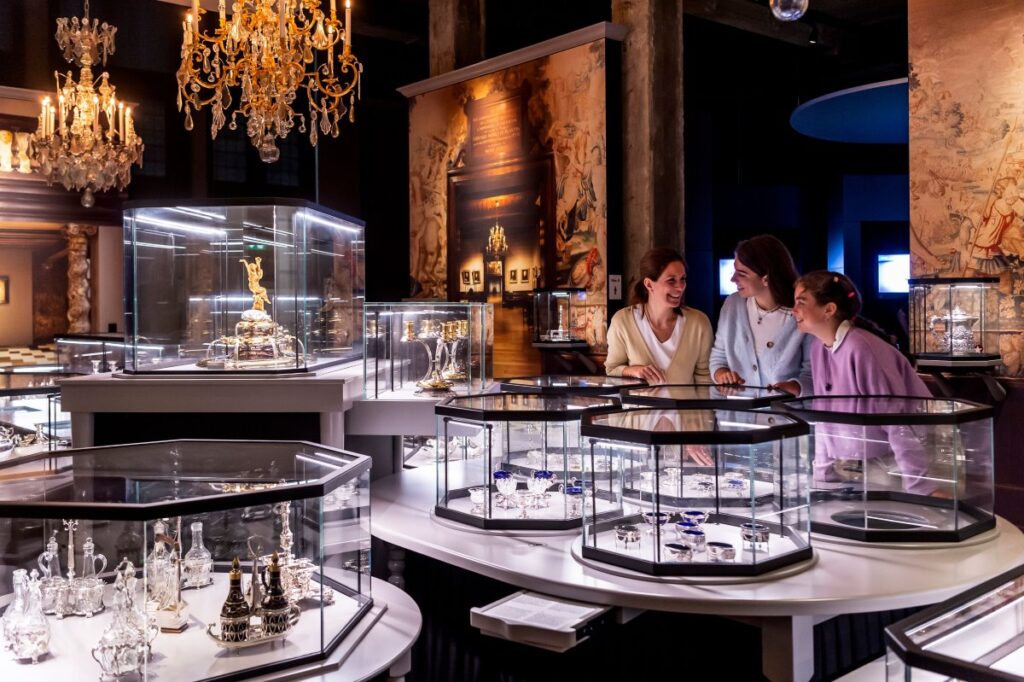
For most visitors, DIVA, the museum for diamonds, jewellery and silver, provides the clearest introduction to the physical materials and craftsmanship behind Antwerp’s diamond story.
The permanent exhibition follows the journey from raw materials through craftsmanship and finished objects. Its galleries explore where diamonds and precious metals come from, how craftspeople work with them, and how these materials become jewellery and other valuable objects.
This is particularly useful because much of Antwerp’s commercial diamond industry cannot simply be opened to tourists.
DIVA effectively fills that gap.
Rather than pretending to be a working factory, it provides the tools, objects and explanations needed to understand processes that would otherwise remain hidden. The collection also places diamond working within the wider traditions of jewellery, goldsmithing and silversmithing.
DIVA can form the core of a diamond-themed visit, while the Diamond District adds the real-world context.
Rather than assigning a fixed two- or three-hour duration to an imaginary single “Diamond Experience,” we would allow half a day if you want to combine the museum with the district without rushing.
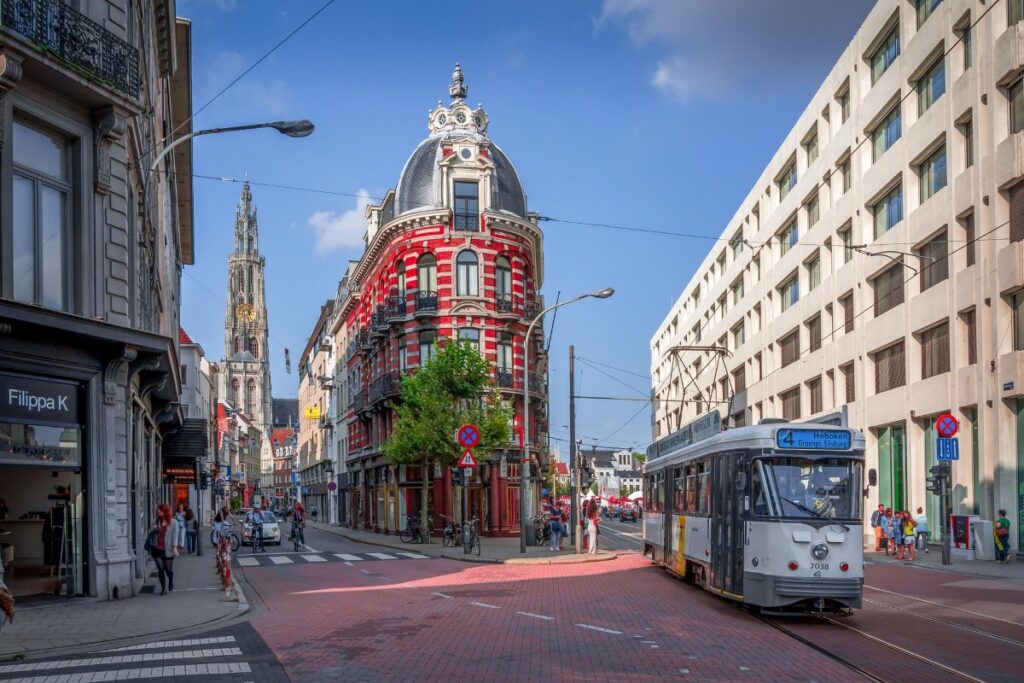
The geography makes this relatively easy. Antwerp Central Station and the Diamond District are close together, while DIVA is in the historic centre, so the diamond story can also be incorporated naturally into a broader day exploring Antwerp.
This experience works particularly well for travelers interested in craftsmanship, industrial heritage, luxury manufacturing and unusual urban industries. Someone expecting a conventional factory floor filled with machinery may be disappointed.
But if you find yourself wondering how an unremarkable rough stone becomes a precisely cut object worth thousands — or sometimes far more — Antwerp provides an unusually good place to investigate that question.
You do not need to be particularly interested in buying jewellery.
In fact, we think the manufacturing story becomes more interesting when you look beyond the finished product in the shop window.
Yes — but think of it as an exploration rather than a single attraction.
DIVA explains the materials and craftsmanship. The Diamond District provides the contemporary industrial setting. And Antwerp itself supplies something a museum cannot reproduce: the knowledge that this centuries-old trade is still operating around you.
It is less spectacular than seeing automotive production up close, as visitors can experience at Volkswagen’s Autostadt and factory in Wolfsburg, and considerably less accessible behind the scenes than a food factory.
But that is precisely what makes it different.
Few products conceal as much expertise behind something so small. Antwerp gives you a chance to understand some of that hidden process.

Japanese woodworking traditions range from interlocking kigumi joints to decorative techniques. This guide compares workshop experiences and shows how working by hand at the bench reveals the logic behind each craft.

A mask workshop in Shkodër connects Venetian carnival traditions with contemporary Albanian craftsmanship. See how the masks are shaped and decorated, and what makes a visit different from browsing a souvenir shop.
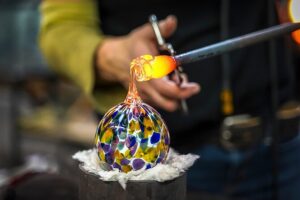
Watching a Murano glassmaker at work brings the island’s craft into focus. Compare factory demonstrations and hands-on workshops, see where the Glass Museum fits into a visit, and learn what to check before booking.